
Dev Update: MPC Mnemonic Backup Flow
Making Recovery-Phrase Experiences Easier to Build
A wallet's recovery phrase can be essential when a user needs to restore access to their wallet. Helping users handle that phrase correctly is therefore an important part of the wallet experience. For developers, building this experience involves more than displaying a list of words and asking users to confirm that they have saved them. The application also needs to guide users through verification, handle imported phrases correctly, and consider how sensitive information is presented on screen.
MPC introduces mnemonic_backup_flow, an open-source Flutter package that provides reusable screens for recovery-phrase backup, verification, and import. It helps wallet developers implement these interactions without building every component from scratch. The goal is to make an important part of wallet development more reusable, so teams can focus on creating better experiences for their users.
A Better Approach to Wallet Backup
A confirmation checkbox can tell an application that a user clicked a button. It cannot establish whether the user actually recorded their recovery phrase. A more meaningful experience gives users an opportunity to interact with the phrase before completing the backup process. Developers must also consider when the phrase becomes visible, what happens when the application moves into the background, and how an imported phrase is validated.
These requirements can involve multiple screens and platform integrations, adding development work to an already sensitive part of a wallet.
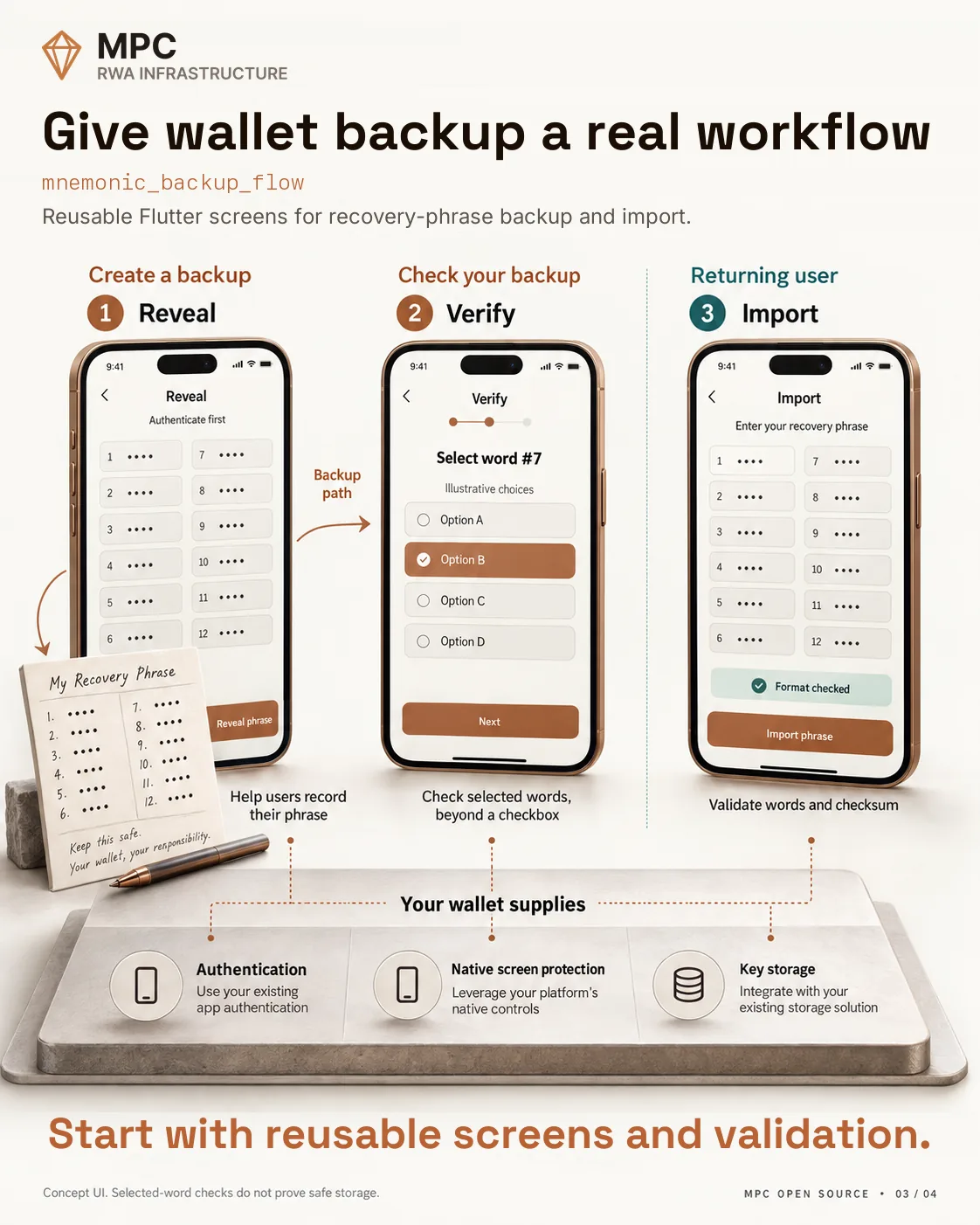
MPC's mnemonic_backup_flow provides reusable components that help Flutter teams implement this journey through three key functions:
- Reveal: Present the recovery phrase as part of the wallet's backup process, with authentication and screen-protection integrations supplied by the host application.
- Verify: Ask users to identify words at selected positions in their phrase, providing a more meaningful confirmation step than a checkbox alone.
- Import: Allow returning users to enter an existing recovery phrase and validate its format.
The verification flow defaults to three selected word positions, with four answer choices per question. Phrase validation supports 12, 15, 18, 21, and 24 words, distinguishing between an incorrect word count, an unrecognized word, and a checksum mismatch.
These components give developers a foundation they can inspect and integrate into their own wallet applications.
Reusable Components for a Sensitive User Journey
The package addresses five recurring design concerns: early disclosure of recovery phrases, screen capture, weak backup confirmation, clipboard residue, and exposure when an application moves into the background.
These are important considerations when designing wallet interfaces. The package provides reusable components and integration points to help developers address them, but it does not eliminate every risk automatically.
The distinction matters because wallet security depends on the surrounding application as well as its interface.
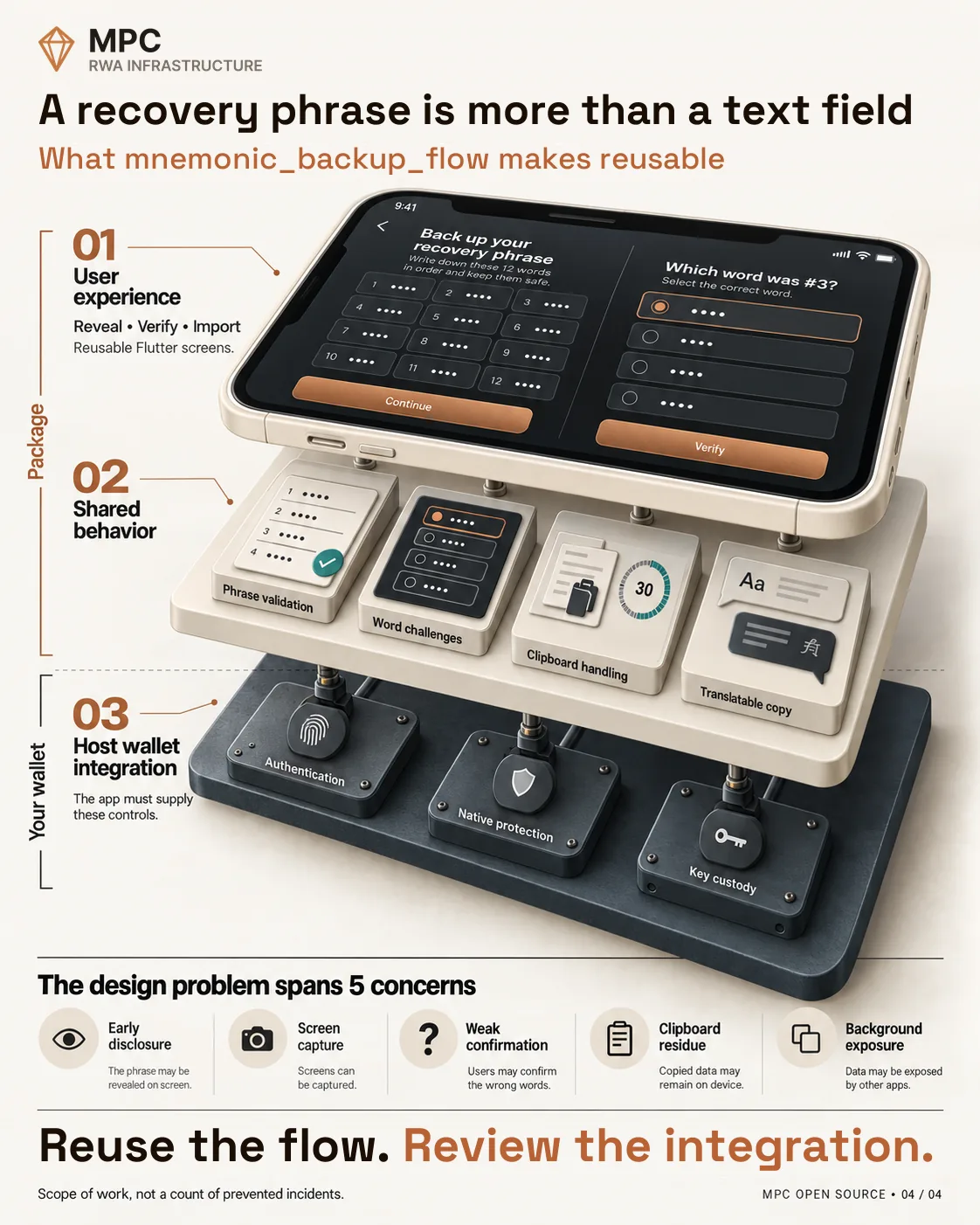
The library does not independently store or encrypt recovery phrases, derive wallet keys, or implement a complete PIN or biometric authentication system. Screenshot protection also depends on platform-level functionality provided by the host application. By making the interface and validation logic reusable, MPC gives developers a starting point they can review, test, and adapt to their own wallet architecture.
Who Can Benefit from It?
The package is designed for Flutter wallet developers who want to implement or improve their recovery-phrase backup experience.
Wallet product and design teams can also use it as a reference for understanding the steps users need beyond a simple confirmation checkbox. Security and QA teams can inspect the screens, validate user flows, and test how the wallet integrates authentication and platform-specific protection.
For example, a team building a wallet-enabled RWA application could integrate the backup flow into its existing onboarding journey. Users would move through recovery-phrase presentation and verification, while the application would manage authentication and the underlying wallet keys.
This approach helps teams reuse the interface components while retaining control over their own security architecture.
Get Started with MPC Mnemonic Backup Flow
Developers can add the package to an existing Flutter project using:
flutter pub add mnemonic_backup_flow
The package provides showMnemonicBackupFlow for the combined authentication, reveal, and verification journey. Developers supply the recovery phrase and connect their application's authentication and screen-protection implementations.
The separate MnemonicImportScreen supports the process of importing an existing phrase and returning validated words to the application.
Before integrating the package into a production wallet, teams should review the documentation and test the complete flow on their supported devices. The host application remains responsible for secure key management and the correct integration of platform-specific protections.
Explore the package through the official resources:
- Flutter package: mnemonic_backup_flow
Building Better Tools for the RWA Ecosystem
Wallet experiences are an important part of making blockchain applications accessible to users. Behind those experiences, developers need practical components they can inspect, reuse, and integrate into their own products.
Through mnemonic_backup_flow, MPC is contributing open-source Flutter infrastructure for recovery-phrase backup, verification, and import. The package addresses a specific development challenge while leaving wallet teams in control of their authentication and key management decisions.
Together with MPC's EVM Log Walker, this release continues the open-source initiative to make useful blockchain development tools available to the wider ecosystem.
Explore mnemonic_backup_flow, try it in a Flutter project, and contribute to making wallet experiences easier to build.
— MPC Team, globalMPC
October 20, 2026