
Dev Update: Your dApp's Numbers, with the Working Shown
Turning Public Blockchain Activity into Reports Anyone Can Check
Blockchain data is public, but turning that data into useful information takes work. A token can generate thousands of transactions, yet understanding how many transactions occurred, which wallets participated, and how activity changes over time requires more than looking at a block explorer.
MPC introduces @globalmpc/dapp-stats, an open-source tool that turns public token activity into daily reports with clearly defined metrics, documented data sources, and the block ranges used for each figure. Developers can run it from a single command or integrate it into their own applications, making blockchain activity easier to measure, review, and share.
The goal is straightforward: help teams turn public blockchain records into useful reports without requiring every project to build its own reporting logic from scratch.
From Public Records to Useful Numbers
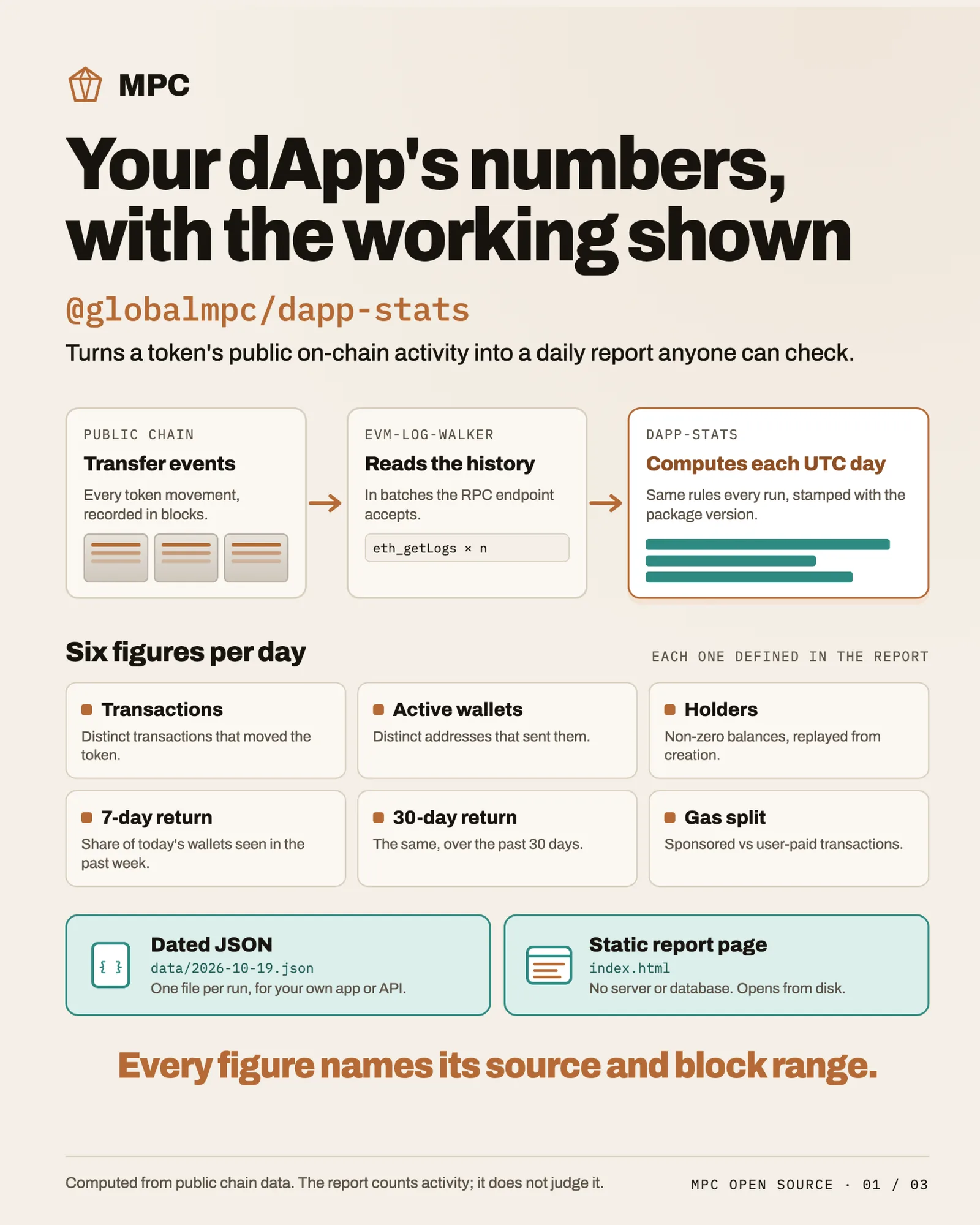
Many decentralized applications, or dApps, use tokens managed by smart contracts. Whenever a standard ERC-20 token is transferred, the blockchain records an event that applications can retrieve and analyze.
The challenge is turning those records into consistent statistics. Teams need to collect historical events, count transactions and participating wallets, reconstruct token holders, and explain how each number was calculated. They also need a way to present the results so that partners, reviewers, or community members can examine the underlying information.
MPC dapp-stats brings these steps into one reusable tool. It uses @globalmpc/evm-log-walker to retrieve token transfer history, then applies documented rules to calculate daily statistics and generate a report.
The package covers six metrics:
- Transactions: the number of distinct transactions that transferred the token during a given day.
- Active wallets: the number of distinct addresses that sent those transactions.
- Holders: addresses with a non-zero token balance, reconstructed from transfer history starting at the token contract's creation.
- 7-day and 30-day return: the share of today's active wallets that were also active during the previous seven or 30 days.
- Gas split: transactions classified as sponsored or user-paid under the package's documented rules.
These measurements provide different views of token activity, from daily transaction volume to wallet participation over time. A wallet address does not necessarily represent one person, and the metrics describe observed activity rather than proving that every transaction represents genuine user demand.
Numbers That Show Their Working
A useful report should explain where its numbers came from, not simply present a collection of statistics. MPC dapp-stats records the data source and block range associated with the daily activity figures, alongside the report's methodology and package version.
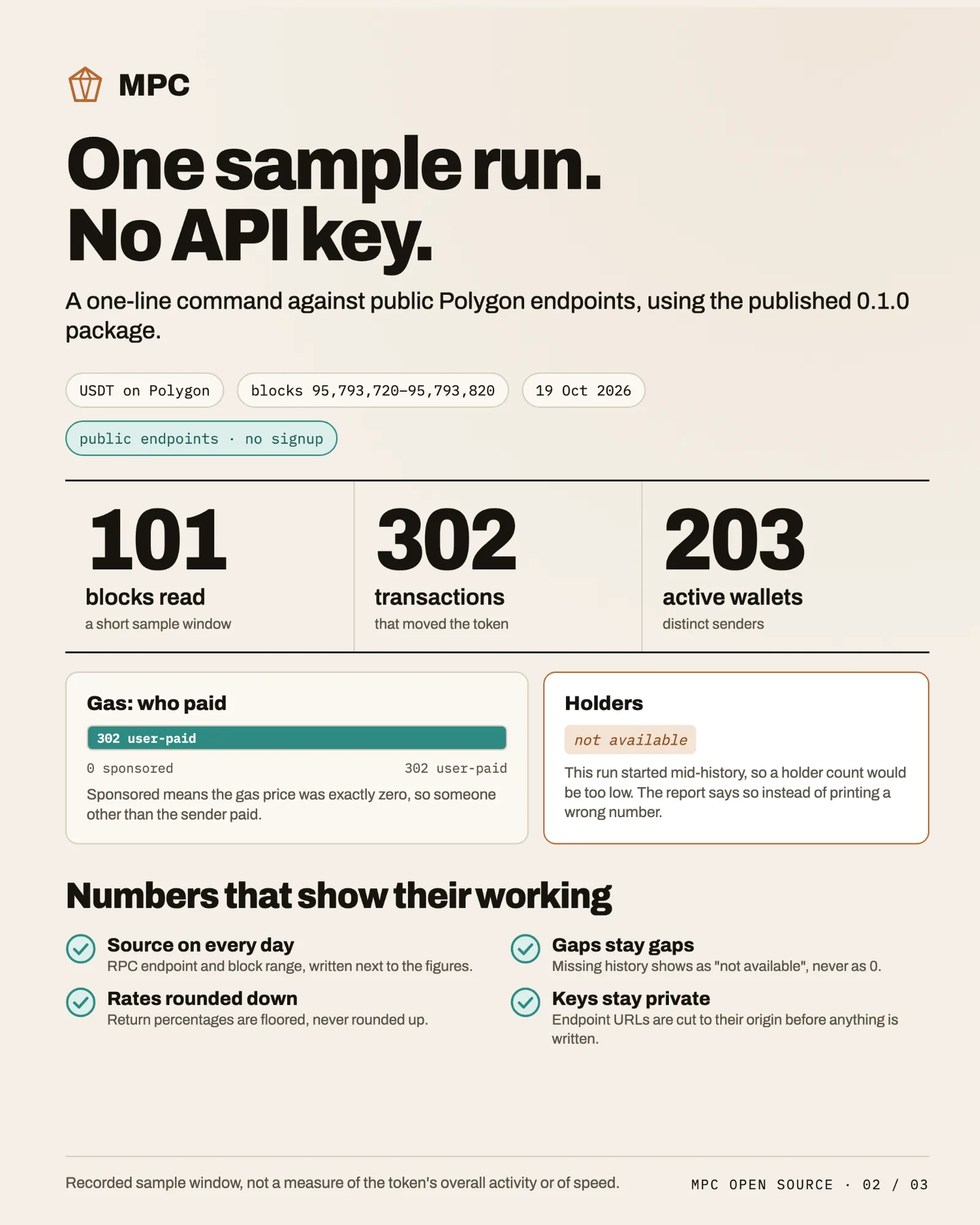
On October 19, 2026, a sample run using USDT on Polygon examined 101 blocks, from block 95,793,720 to block 95,793,820. Using public Polygon endpoints without an API key, the run took approximately eight seconds and reported 302 transactions from 203 active wallets.
The sample also showed holders as unavailable because the collection began partway through the token's history. Rather than presenting an incomplete holder count as accurate, the report identifies the missing historical coverage.
These results demonstrate what the package produced in one documented test, not a guarantee of similar execution times or results for every token and endpoint. Public endpoints generally serve limited historical ranges, while a full report requires an archive endpoint and access to the token's history from its creation block.
Reports Built for Real-World Workflows
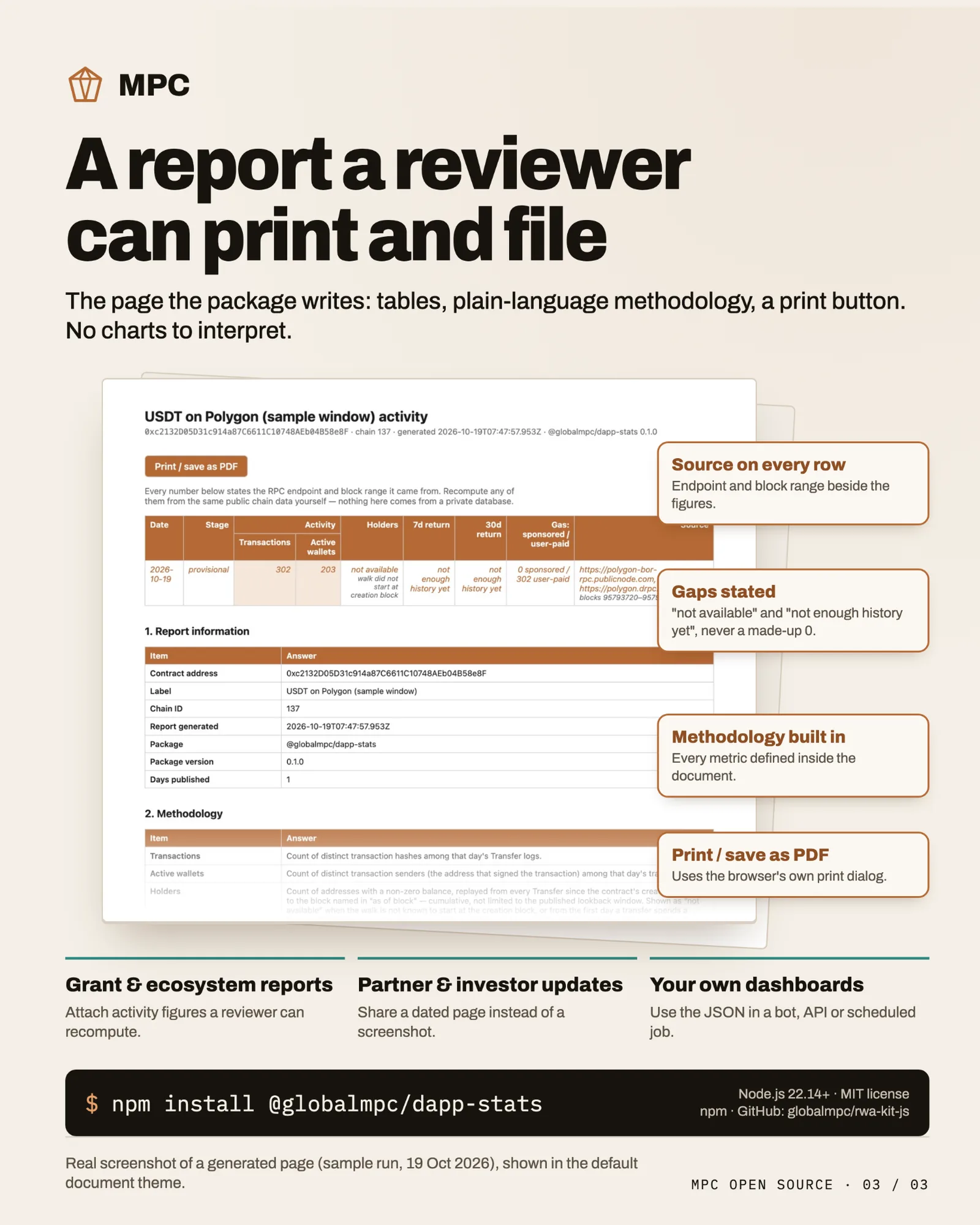
The package generates two main outputs: a dated JSON file containing the calculated data and a standalone HTML report that can be opened locally or published on a static website.
The HTML report includes daily figures, source information, contract details, package version, and plain-language methodology. Readers can also print the page or save it as a PDF through their browser, making the report easier to distribute and review.
For RWA teams, these capabilities can support reporting on token activity. dApp teams can use the data to monitor participation over time, while developers can incorporate the JSON output into their own dashboards, APIs, or scheduled reporting workflows.
The tool counts activity from standard ERC-20 transfer events. It does not determine whether activity is genuine, detect bots or wash trading, or independently verify an off-chain asset. Its purpose is to make defined on-chain measurements easier to reproduce and inspect.
Get Started with MPC dapp-stats
Developers need Node.js 22.14 or later and an ERC-20 token contract on a supported EVM network. The package supports BNB Chain, Polygon, Ethereum, Base, Arbitrum, and Optimism, including their documented testnets.
For a quick test, run the package through npx:
npx --package @globalmpc/dapp-stats dapp-stats 0xYourTokenAddress \
  --network polygon \
  --from <recent-block-number> \
  --to latest \
  --days 1 \
  --out ./activity \
  --open
Replace 0xYourTokenAddress with the token contract address and <recent-block-number> with a recent block number supported by the selected public endpoint. This example is intended for a short test, since public endpoints may not provide the complete historical data needed for a full report.
For production reporting, developers should configure an archive endpoint and identify the token's creation block when holder counts are required. The package documentation explains the available options, report format, and integration methods.
Explore the package and its source code:
- npm package: @globalmpc/dapp-stats
- GitHub repository: globalmpc/rwa-kit-js
- Issues and contributions: GitHub Issues
Building More Transparent Blockchain Reporting
Public blockchain records provide a foundation for measuring token activity, but useful reporting also requires clear definitions and traceable calculations. Through dapp-stats, MPC is contributing an open-source tool that helps developers turn those records into daily reports that other people can inspect and independently recompute.
Together with MPC's EVM Log Walker, this release continues the initiative to make practical blockchain development tools available to the wider ecosystem.
Explore @globalmpc/dapp-stats, test it against a token contract, and build your own reporting workflow from public on-chain data.
— MPC Team, globalMPC
November 2, 2026