
Dev Update: Turn Blockchain History into Usable Data with MPC EVM Log Walker
Making Blockchain Data Easier to Work With
Blockchains record a wealth of information, from token transfers to smart contract activities. This data can power wallet histories, analytics dashboards, and real-world asset (RWA) applications. However, collecting that information efficiently can be more complicated than it sounds.
Imagine trying to retrieve thousands of pages from a public archive, only to discover that you can request a limited number of pages at a time. You need to figure out the limits, divide your requests into smaller batches, and remember where you stopped.
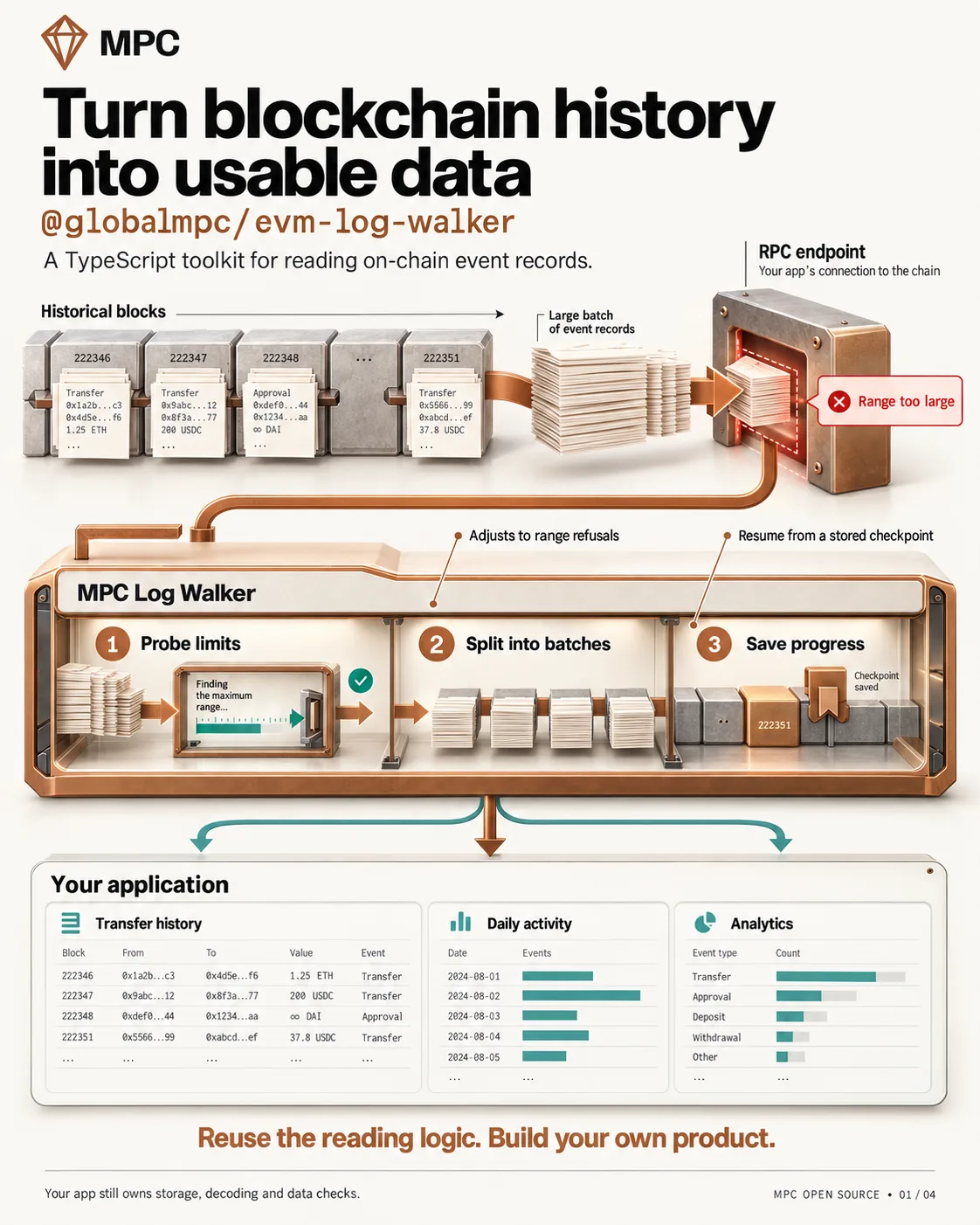
Developers face a similar challenge when collecting historical blockchain data. Different data providers have different request limits, and large requests can fail when they exceed those limits. MPC introduces @globalmpc/evm-log-walker, an open-source toolkit designed to make this process easier. It helps developers retrieve historical blockchain events in manageable batches, adapt to endpoint limitations, and save progress so collection can resume later.
The goal is straightforward: make the process of accessing blockchain history more manageable, so developers can focus on building useful applications with the data.
From Raw Blockchain Records to Useful Information
When a smart contract performs certain activities, it can emit event logs that record what happened. Developers can collect these records to build token transfer histories, track activity, and power data-driven applications.
The challenge is that blockchain data providers do not all handle requests in the same way. A request covering too many blocks or returning too many results may be rejected, forcing developers to adjust their approach.
MPC EVM Log Walker helps simplify this process through three key capabilities:
- Discover endpoint limits. It tests what a particular endpoint can handle for a given event filter, helping developers determine an appropriate request range.
- Collect data in manageable batches. It divides historical reads into smaller requests and adjusts when an endpoint rejects a requested range.
- Save progress and resume. It provides checkpoint support that applications can use to remember completed work and continue longer collection tasks.
Together, these capabilities provide reusable building blocks for collecting historical blockchain data without requiring every development team to implement the same request-handling logic from scratch.
Real-World Measurements, Not Just Promises
MPC's documented tests demonstrate how much endpoint capabilities can vary. A test using a dense WBNB event filter on BSC PublicNode worked with 100-block request spans and a 20,000-result cap. Meanwhile, the tested public opBNB endpoints accepted 50,000-block spans. In a separate test, the toolkit collected 12,534 WBNB transfer events across 306 blocks in four log requests. Additional requests were needed to probe endpoint capabilities and retrieve timestamps.
These results highlight an important consideration for developers: the right request size depends on the endpoint and the activity being queried. The measurements reflect specific tests conducted on a particular date, rather than permanent limits or a guarantee of similar results across all providers.
By helping developers adapt their requests to the conditions they encounter, EVM Log Walker offers a practical starting point for more manageable historical data collection.
What Can Developers Build with It?
Wallet developers can use collected event records to build token activity histories. Analytics teams can retrieve historical events to study activity over time. RWA platforms can use on-chain records as inputs for reporting and monitoring their token activity.
For example, a developer building an RWA dashboard could use EVM Log Walker to collect historical token transfers, decode the relevant information, and store it in a database. The application could then present that information through a searchable transaction history or an activity chart.
The toolkit handles the collection process, while the developer remains responsible for interpreting, storing, and validating the data. On-chain events alone do not establish ownership of an off-chain asset or prove regulatory compliance.
Get Started with EVM Log Walker
Getting started requires Node.js 22.14 or later and an ES-module JavaScript or TypeScript project. Install the package using npm:
npm install @globalmpc/evm-log-walker
Developers can then use its available functions to configure an RPC connection, test endpoint capabilities, and collect historical event logs.
For longer collection tasks, the documented walking and checkpoint interface can help applications resume from previously saved progress. Developers should also implement their own event decoding, data storage, replay handling, and independent validation.
Explore the package and its implementation through the official resources:
- npm package: @globalmpc/evm-log-walker
- GitHub repository: https://github.com/globalmpc/rwa-kit-js
- Issues and contributions: GitHub Issues
Building Better Tools for the RWA Ecosystem
Accessible blockchain data is an important building block for applications that need to turn on-chain activity into useful information. Through EVM Log Walker, MPC is contributing open-source infrastructure that helps developers handle the practical challenges of reading blockchain history.
For teams building wallets, analytics platforms, and RWA applications, the package provides reusable tools to simplify data collection and reduce the need to rebuild the same underlying logic.
Explore the package, try it with your own RPC endpoint, and contribute to making blockchain data easier to work with.
— MPC Team, globalMPC
October 16, 2026