
Mining RWA Registry: 12 Projects, One Set of Fields, a Source for Each
A public index of projects that tokenize mining and mineral assets, or build infrastructure for them. Each field comes from the project's own material, listed under Sources, and was checked on 16 November 2026. Sorted alphabetically; not a ranking.
The Mining RWA Registry is a public index of projects that tokenize mining and mineral assets, or build infrastructure for them. Version 1 lists 12 projects on the same set of fields. Each field comes from the project's own published material, listed per project under Sources, and was checked on 16 November 2026.
Last checked: 16 November 2026. The list is sorted alphabetically. It is not a ranking, not investment advice and not an endorsement.
What are the four backing models?
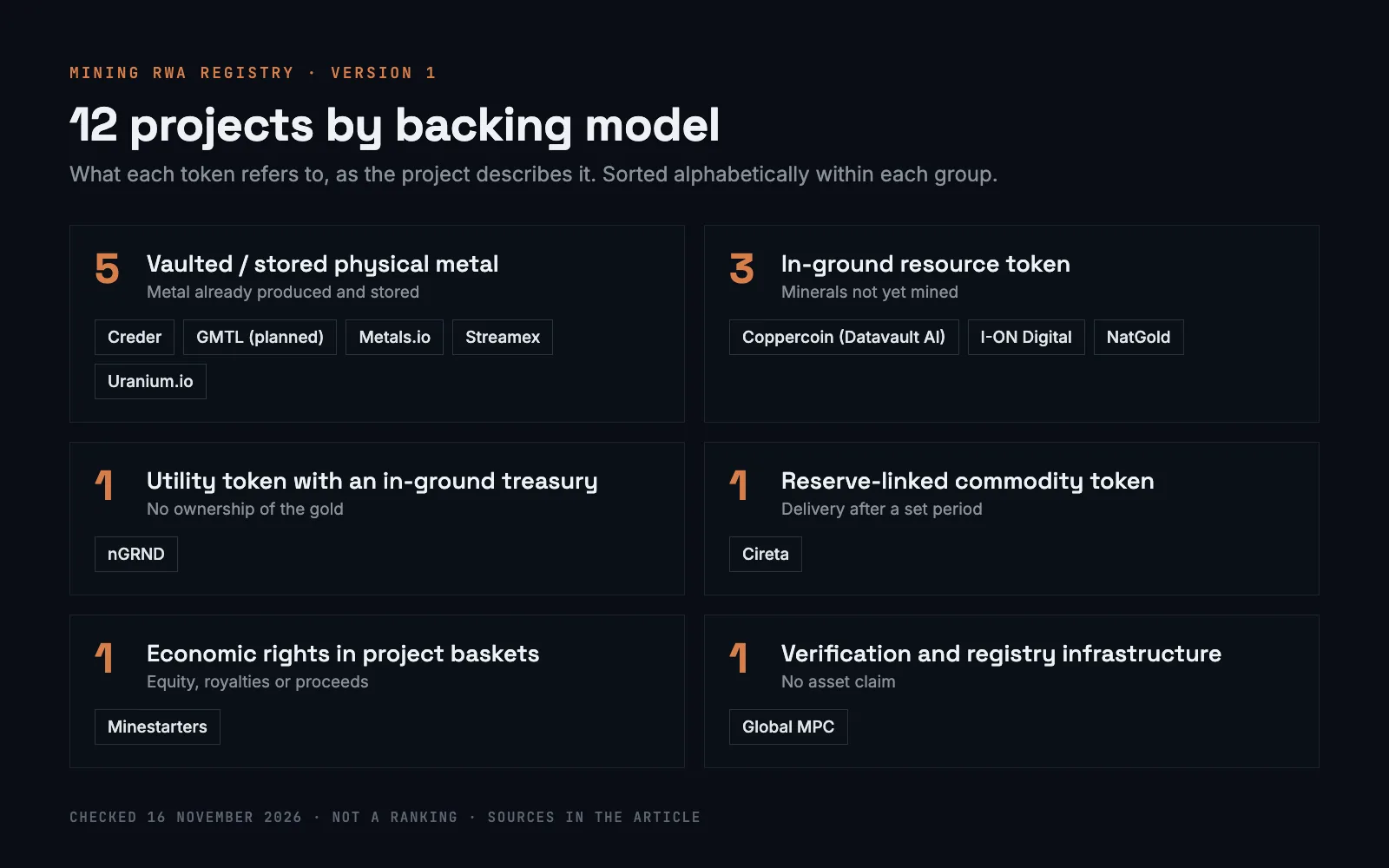
Mining RWA projects connect mineral projects, commodities or project information to digital records and tokens. Behind the 12 entries below are four backing models.
- Vaulted metal. A token is connected to refined metal held by a custodian, trustee or other disclosed storage provider. The holder's right may be direct ownership, beneficial co-ownership, a fund interest or a contractual claim, depending on the documents. Relevant evidence includes bar or lot identifiers, custody statements, reserve reconciliations, independent examinations and redemption procedures. Issuer, custodian, legal, liquidity and delivery risk remain.
- In-ground resource. A token references mineralisation or a classified resource that remains unmined. It may represent an economic interest, contractual participation or exposure to a project, but that does not automatically convey mineral title or bullion ownership. Geological confidence and economic viability are different assessments, and neither alone guarantees production or market value.
- Royalty or revenue. Holders receive a defined share of specified project cash flows, production proceeds or leasing income. The legally documented entitlement, not gross mine revenue, determines the economic exposure: check the payer, revenue definition, deductions, seniority, term and audit rights.
- Verification infrastructure. Source documents, professional reviews, status changes and data-integrity records are connected so that users can trace who reviewed what evidence, when and within which scope. The infrastructure does not by itself issue an asset token or give rights to minerals, metal, royalties or production. Global MPC's Registry dApp is in this category and is in development.
Which projects tokenize mining or mineral assets?
The first table shows what each token refers to, how it is backed, which chain it uses and where it stands today. "Not stated" means the project's own pages do not say.
| Project | What the token refers to | Backing model | Chain | Token and status |
|---|---|---|---|---|
| Cireta | Gold reserves in the Wassa Gold District, Ghana; copper cathode from the Kinusi mine, Tanzania | Gold in audited vaults on the project page; in-ground reserves in the whitepaper | Ethereum for the gold token; not stated for copper | WMAU (gold); Kinusi copper token (KCT on the site, KCU in the copper whitepaper). Gold shown as "Future Shipment", participation open |
| Coppercoin (Datavault AI) | In-ground copper resources of Coppercore Inc. | In-ground resource token | Not stated | Coppercoin. Announced March 2026; no launch announced as of 13 November 2026 |
| Creder | Physical gold through BDAN e-gold | Vaulted physical metal (gold digital voucher) | Kaia | Gold digital voucher NFTs. Live |
| Global MPC | No asset. Builds verification and registry infrastructure for mining project data | Verification and registry infrastructure | Designed for BNB Smart Chain | $MPC, planned utility token. Pre-TGE; no token contract address published |
| GMTL | Refined gold to be bought under a forward purchase agreement and vaulted | Vaulted physical metal (planned) | BNB Smart Chain | Series A and Token B, plus a GMTL utility token. Planned; sales not yet open |
| I-ON Digital | In-situ gold reserves | In-ground resource token | Own hybrid blockchain platform; no public chain named | IONau. Presented as live on its site |
| Metals.io | Stored cobalt, nickel, copper, uranium, gold and a strategic metals basket | Vaulted physical metal | Etherlink (Tezos layer 2) | xCo, xNi, xCu, xU3O8, VNXAU, RARE. Live |
| Minestarters | Equity, royalties or commodity proceeds linked to junior mining projects | Tokenized economic rights in project baskets | Not decided | Vault tokens and a provisional $MINE token. Planned |
| NatGold | In-ground gold left unmined ("NatGold Certified Resources") | In-ground resource token | Ethereum | NATG. Live; both listed projects shown as fully minted |
| nGRND | A treasury of in-ground gold kept unmined | Utility token with an in-ground gold treasury | Base | NGRND. Announced; token purchases shown as "coming soon" |
| Streamex | Allocated physical gold | Vaulted physical metal (yield-bearing) | Trades on Solana; issuance chain not stated | GLDY. Launched 25 February 2026, per its own guide page |
| Uranium.io | Uranium concentrate (U3O8) stored at a Cameco-operated facility | Vaulted physical commodity | Etherlink (Tezos layer 2) | xU3O8. Live; the site says it is "evolving into Metals.io" |
Which projects name a reporting standard or publish a technical report?
A mineral reporting code such as NI 43-101, JORC or S-K 1300 sets how a resource or reserve may be reported, and who signs the report. These codes cover minerals still in the ground, not metal already produced and stored. The second table shows what each project says about its evidence and about redemption.
| Project | Reporting standard named | Qualified Person named | Technical report public | Redemption right |
|---|---|---|---|---|
| Cireta | Yes (NI 43-101 and JORC) | Not stated | Not stated | Yes, after 12 months |
| Coppercoin (Datavault AI) | Not stated | Not stated | Not stated | Not stated |
| Creder | Not stated | Not stated | Not stated | Yes, for the user who minted the voucher |
| Global MPC | No report issued | Not applicable | No report issued | No. $MPC conveys no ownership of minerals |
| GMTL | Not stated | Not stated | Not stated | Planned for Series A holders |
| I-ON Digital | NI 43-101 on its collateral page; not named in its 10-K | Not stated | Not stated | Not stated for holders |
| Metals.io | Not stated | Not stated | Not stated | Yes, with conditions per metal |
| Minestarters | Not stated | Not stated | Not stated | Not stated |
| NatGold | Yes (NI 43-101; JORC and S-K 1300 also accepted) | Yes | Yes | No |
| nGRND | Yes (NI 43-101) | Not stated | Not stated | No |
| Streamex | Not stated | Not stated | Not stated | Redemptions settle via Wintermute; physical delivery terms not stated |
| Uranium.io | Not stated | Not stated | Not stated | Yes, with conditions |
For Global MPC, the first reference case is Tsagaan Tolgoi, Mongolia, at the exploration stage. No JORC or other CRIRSCO-compliant resource or reserve report has been issued for it. See Technical Reports.
How should each field be read?
- What the token refers to: the asset or right the project says the token is linked to, in its own words.
- Backing model: a short label for the structure. In-ground resource tokens refer to minerals that have not been mined. Vaulted tokens refer to metal already produced and stored. Tokenized Gold vs In-Ground Resource Tokens explains the difference, and Tokenizing In-Ground Mineral Resources compares the four models.
- Chain: the blockchain the project names for the token. A token standard such as ERC-3643 is not a chain.
- Token and status: Live, Announced or Planned, as the project presents it on the check date.
- Reporting standard named: whether the project's own material names a mineral reporting code.
- Qualified Person named: whether a named Competent or Qualified Person signs the resource figures.
- Technical report public: whether the report itself is linked, not only cited.
- Redemption right: whether holders can exchange the token for the underlying asset, and on what terms.
What should you check before relying on any project?
Use the same five questions for every project, including Global MPC. Compare documented attributes, not price, market capitalisation or promotional claims. No score or ranking is assigned.
- Backing and rights. Identify the legal issuer, asset owner, project entity and the exact right the token represents. A mineral estimate is not a title deed or a bullion claim.
- Evidence. Check the published licences, technical reports and source records, with their effective dates, methodology and stated limitations. A published document is not automatically independently verified.
- Sign-off. Identify who reviewed the evidence, their professional qualifications and authority, and the scope of the review.
- Custody, counterparties and token controls. For physical metal, identify the custodian, storage location, trustee, insurance and reconciliation process; for royalties or revenue, the payer and payment terms. Verify the contract address, chain, transfer restrictions, administrator powers and redemption process. A platform announcement is not proof of a live contract.
- Eligibility and regulation. Read the offering documents, jurisdictional restrictions, investor tests, KYC and AML requirements, fees and risk disclosures. Products differ: some are open to the public, others only to accredited, qualified or regulated participants.
For financing routes by project stage, see Mine Financing Options and Where Tokenization Fits. For one project compared in depth, see NatGold vs MPC.
What does each project say about its legal status?
These are the projects' own descriptions, not an assessment.
- Cireta: issuing SPVs incorporated and licensed under RAKICC (Ras Al Khaimah); access restricted in some jurisdictions.
- Coppercoin (Datavault AI): described as "an easy, compliant way to participate in the copper market"; trading on regulated venues is targeted.
- Creder: describes the product as a digital voucher; no licence or regulatory status stated.
- Global MPC: holding $MPC, if issued, conveys no equity, voting rights in a corporate entity, fractional ownership of minerals or claim to mining revenue (Terms of Use, section 3).
- GMTL: available to verified investors after KYC and AML onboarding; the utility token is "not equity or debt".
- I-ON Digital: describes IONau as a "gold-backed digital security"; resale structured for qualified institutional buyers under Rule 144A.
- Metals.io: describes the tokens as spot commodities; its terms say it is not registered with a securities regulator.
- Minestarters: for self-certified sophisticated investors; a Bermuda DABA application submission shown as in progress on its roadmap.
- NatGold: a MiCA "other crypto-asset" white paper, not approved by any competent authority; the token "is not categorised as a financial instrument".
- nGRND: "a utility token, not a security"; no ownership of gold.
- Streamex: a tokenized security offered under Regulation D Rule 506(c) to accredited investors only.
- Uranium.io: a MiCAR white paper not approved by any competent authority; physical delivery only for regulated persons.
How was the registry compiled?
- Own sources first. Each field is taken from the project's website, whitepaper, terms or its own filings and releases. Third-party sources are used only where the project is silent, and are named as such.
- "Not stated" where silent. A blank on the project's side is recorded, not filled in.
- Dated checks. Every field was checked on 16 November 2026. Projects change quickly; read the date before relying on a field.
- Where a project's own pages disagree, both versions are shown, and figures such as ounces or tonnes are left out.
- Not included in version 1: Nature's Vault and AMA-AMBIOGEO (Supernova project). Neither had a current project page that could be checked: Nature's Vault's own pages show no token activity after 2023, and the AMA Resources domain named in the 2024 announcement is not registered.
What is the registry not?
It is not a ranking, a rating or advice to buy or sell anything. Listing does not mean a project is endorsed, verified or safe. Global MPC is listed on the same fields as every other project and is not placed first. A token's status says nothing about whether the asset behind it exists or is worth what is claimed; see the limits of on-chain verification.
Sources
- Cireta: cireta.com, project page, FAQs, Wassa gold whitepaper, Kinusi copper whitepaper
- Coppercoin (Datavault AI): announcement, 31 March 2026, exchange agreement, 29 May 2026, press releases
- Creder: creder.biz, The Mining Club FAQ
- Global MPC: FAQ, Terms of Use, Technical Reports
- GMTL: gmtokenization.com, legal and regulatory
- I-ON Digital: iondigitalcorp.com, collateral framework, Form 10-K
- Metals.io: metals.io, cobalt and nickel launch, copper launch, third-party report
- Minestarters: minestarters.com, FAQs
- NatGold: natgold.com, white paper, MiCA white paper
- nGRND: ngrnd.io, docs, white paper
- Streamex: streamex.com, GLDY guide, terms
- Uranium.io: uranium.io, MiCAR white paper (archived)
Uranium.io and Metals.io block automated access, so their pages were read from copies archived between December 2025 and October 2026. Metals.io's copper token (xCu) is not on those archived pages; it is taken from a third-party report of the launch. Streamex's GLDY product page, home page and terms still carry pre-launch wording, while its guide page says GLDY launched on 25 February 2026.
How can a project correct its entry?
Send the correction with a link to the project's own source through the contact page. Corrections are checked against that source and logged below with a date.
Changelog
- 16 November 2026: Version 1 published with 12 projects.
- 18 November 2026: Added the four backing models and the five questions to check before relying on any project.
MPC Team, globalMPC
November 16, 2026