
Tokenizing In-Ground Mineral Resources
Vaulted metal, in-ground resource, production-linked and registry models compared: what backs each token, the evidence behind it and the limits.
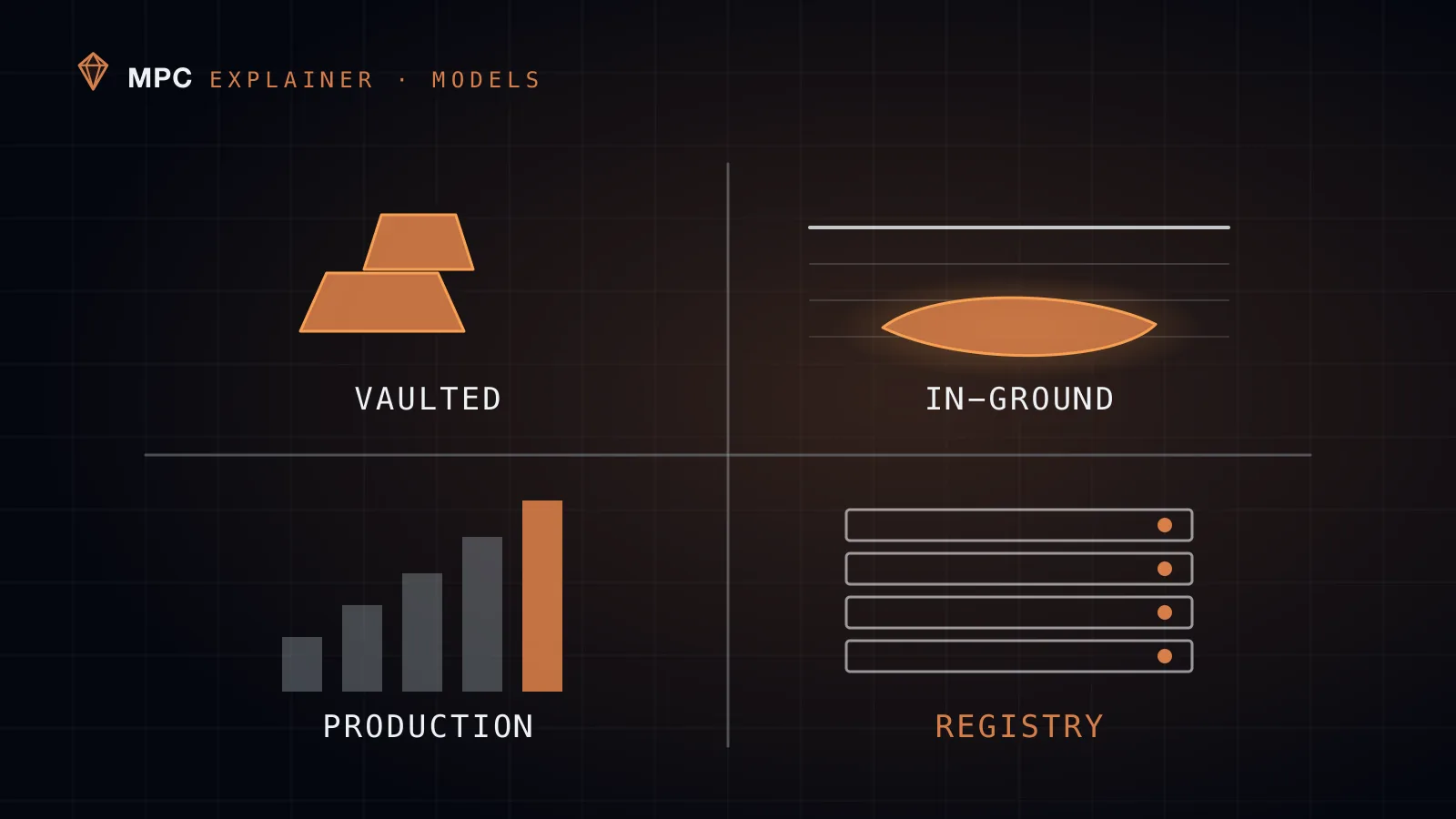
Tokenizing in-ground mineral resources means connecting digital tokens to mineral deposits that remain underground rather than refined metals held in custody. The structure determines what backs each token, what rights holders receive, how resources are verified and which risks apply. Four models illustrate the differences between physical commodities, underground resources and verification infrastructure.
What does "in-ground" mean?
An in-ground resource refers to mineral-bearing material that remains within its original geological location and has not been extracted. In-ground assets may be associated with geological estimates, mineral rights and technical reports. Their quantities, recovery potential and economic viability remain subject to geological, technical, environmental, legal and commercial conditions.
This is fundamentally different from a metal product held in an identifiable warehouse or vault.
The distinction also matters when comparing a mineral resource with an ore reserve. A Mineral Resource represents a concentration of material with reasonable prospects for eventual economic extraction, while an Ore Reserve represents the economically mineable portion of a Measured or Indicated Mineral Resource after applying relevant Modifying Factors.
A resource estimate does not automatically establish an economically viable mining operation. For a deeper explanation, see Proof of Reserves vs Ore Reserve.
The four models compared
The term tokenized mineral can describe several different arrangements. The underlying asset, contractual rights, verification requirements and redemption mechanisms determine what a holder actually receives. Four models help distinguish these arrangements.
| Dimension | Vaulted metal tokens | In-ground resource tokens | Production or stream-linked tokens | Verification and registry infrastructure |
|---|---|---|---|---|
| What backs the token | Refined physical metal held in custody. | An economic interest, contractual claim or reference to qualifying underground mineral resources and associated rights. | Contractual rights linked to future production, metal delivery or specified revenue streams. | No commodity or mineral ownership. The system supports project information and verification records. |
| Evidence standard | Custody records, inventory statements, independent audits and metal specifications. | Geological reports, resource estimates, mineral rights, technical assessments and legal documentation. | Executed streaming, royalty, offtake or production agreements, alongside project and counterparty information. | Source documents, professional verification records, provenance, timestamps and document integrity references. |
| Redemption right | May permit physical metal delivery, subject to terms, eligibility and minimum quantities. | Depends entirely on the legal structure. Some offer no physical redemption. | Defined by the relevant delivery, payment or contractual arrangement. | No commodity redemption right. |
| Main risk | Custody, counterparty, redemption, liquidity and smart contract risk. | Geological uncertainty, extraction feasibility, mineral rights, valuation and regulatory classification. | Production failure, counterparty default, commodity prices and contractual performance. | Inaccurate source data, incomplete verification, system vulnerabilities and operational dependencies. |
| Typical legal framing | Custodial ownership, beneficial interest or other commodity-related contractual rights. | Security, economic interest, contractual claim or another instrument depending on structure. | Royalty, streaming, debt, offtake or security-related contractual arrangements. | Technology, registry and verification services. |
| Public examples | PAXG, XAUT, KAG, xU3O8 and Metals.io products. | NatGold, I-ON Digital's in-situ gold offering and Datavault AI's Coppercoin programme. nGRND requires separate token-level analysis. | Project-specific streaming, royalty or metal-delivery arrangements. | Global MPC's mining verification and registry infrastructure, in development. |
These four models should be evaluated independently. A token that represents physical metal in a licensed facility has a different evidence foundation from one referencing gold that has not been extracted.
Similarly, verification and registry infrastructure can support the documentation of a mining project without becoming the legal issuer or owner of the underlying mineral rights. The limits of on-chain verification set out what a registry record does and does not establish.
Market context
CoinGecko's 2026 RWA report recorded a tokenized commodities market capitalisation of approximately $5.55 billion at the end of the first quarter of 2026, with gold-backed tokens such as XAUT and PAXG accounting for most of the growth. That figure covers vaulted products. It does not show how much capital is associated with underground mineral resources, and no comparable standard figure exists for in-ground tokens. Tokenized Gold vs In-Ground Resource Tokens sets out the market data for gold with source and date. The whitepaper chapter Market Opportunity covers the mining RWA market and shared infrastructure.
Tokenized copper, silver and uranium today
Different metals illustrate how commodity tokenization can use different forms of backing. Some products represent physical materials in custody. Others refer to mineral deposits that have not been mined.
Tokenized copper: physical inventory and underground resources
Metals.io offers xCu, a blockchain-based product representing fractional ownership of physical copper, according to a third-party report of the launch. Its platform describes the underlying metals as stored in licensed facilities, with redemption subject to asset-specific conditions. Its copper product therefore belongs to the physical commodity model. See the Metals.io platform.
A different arrangement was announced by Datavault AI and Coppercore Inc. on 31 March 2026. Their Coppercoin programme was announced as a structure representing pro-rata ownership interests in underlying in-ground copper resources. The announcement described each token as corresponding to five pounds of underlying high-grade copper resources, with pricing linked to the COMEX copper benchmark.
A token representing five pounds of referenced underground copper is structurally different from a token representing five pounds of physical copper held in a warehouse. The announcement described an intended issuance programme. It is not independent confirmation that the programme was issued or that its underlying resource claims have been independently established.
When checking whether a tokenized copper product is backed by real metal, examine exactly which portion is physically stored, which portion consists of ore stockpiles and which portion refers to geological resources.
Tokenized silver: allocated physical bullion
Tokenized silver generally follows a conventional commodity custody model. Kinesis Silver (KAG), for example, describes each unit as backed 1:1 by physical silver bullion. Vaulting, insurance and redemption terms are set out in the issuer's own documentation and should be read there.
For a physical silver token, the evidence centres on inventory, ownership allocation, custody and redemption. For an in-ground silver model, the evidence would need to address geological information, mineral rights, resource classification and the legal structure of the digital instrument. The phrase tokenized silver therefore does not identify a single backing model.
Gold in the ground versus vaulted gold
Paxos Gold (PAXG) and Tether Gold (XAUT) each describe a token as representing one fine troy ounce of refined gold held in custody, subject to their terms. Gold in the ground has not been extracted, processed, transported or placed into a storage facility, and its potential value depends on the deposit, geological confidence, extraction feasibility and legal rights. In-ground gold should not be described as equivalent to physical gold ownership without clearly defining the rights the token represents. Tokenized Gold vs In-Ground Resource Tokens compares the two in detail.
Uranium and other critical minerals
Uranium.io's xU3O8 is described as a digital token representing fractional ownership of physical uranium ore concentrate. The platform identifies Cameco's storage facility as the location of the underlying material and states that proof-of-reserves information is updated through monthly statements. Physical delivery is subject to regulatory eligibility and approved custody arrangements. This is a stored-product model rather than a token representing an unmined uranium deposit.
Metals.io also lists cobalt, nickel, copper, uranium, gold and a strategic metals basket, described as physical materials held in licensed facilities.
Critical-mineral tokens that refer to underground deposits would require a separate assessment of mineral rights, geological reports, extraction economics and project-specific legal structures. A token referencing stored U3O8 and one referencing an underground uranium resource do not represent the same asset or risk.
Public examples of in-ground mineral tokenization
Several organisations have publicly described structures involving underground mineral resources, and their rights differ:
- NatGold describes its token as an economic interest referencing a percentage of qualifying, certified in-ground gold resources. Its Terms of Service state that the token conveys no direct legal title to mineral rights or possession of mined gold, and its MiCA white paper notes no physical redemption claim and no right to mining proceeds. NatGold vs MPC compares its model with MPC's.
- nGRND describes its NGRND utility token as conferring no ownership of gold, redemption or repayment right. Any separate gold token it describes is a future instrument.
- I-ON Digital describes its IONau offering as a gold-backed digital security associated with gold that remains underground.
- Coppercoin (Datavault AI and Coppercore) is an announced programme referencing pro-rata interests in in-ground copper resources.
The Mining RWA Registry compares these and other projects on the same fields, with each project's own sources. An issuer's name or project category is not enough to understand the underlying asset; the actual terms, rights, custody structure, reporting evidence and token functionality matter.
How is an in-ground resource evidenced?
An underground mineral deposit requires technical evidence before its characteristics can be represented in a formal reporting framework. The evidence may include:
- Geological mapping and field observations.
- Drilling logs and sample records.
- Laboratory assay results.
- Geological modelling.
- Estimation methodology.
- Mineral rights and licence documentation.
- Technical reports and supporting professional assessments.
Recognised reporting frameworks include JORC, NI 43-101 and S-K 1300. Each defines requirements for public disclosure and sets professional responsibilities for the people preparing or supervising technical information. A Qualified Person or Competent Person must have relevant qualifications and experience for the work under the applicable framework.
A technical report is evidence of a defined professional assessment. It is not automatically evidence that a digital token provides enforceable ownership of the deposit or that its economic valuation is accurate.
The frameworks also distinguish exploration results from mineral resources and reserves. An inferred resource has lower geological confidence than an indicated or measured resource, and an Ore Reserve requires further technical and economic assessment. A project cannot simply translate an estimated quantity of underground metal into an equivalent quantity of vaulted bullion. The classification ladder is explained in Proof of Reserves vs Ore Reserve.
What do critics and regulators say?
Critics point out that a geological estimate is not an economic asset value: extraction costs, processing, infrastructure, permitting, taxation, royalties and commodity prices decide whether material can be mined at a profit, and a deposit may never be extracted at all. A token may also reference a deposit while giving its holder no title to the mineral rights, no right to physical delivery and no claim on mining proceeds, so the token's legal documents must be read separately from its marketing.
On 2 November 2026 the British Columbia Securities Commission published "Fool's Gold": Crypto Tokens Backed by Purported Mineral Deposits, which states that the existence of a technical report does not mean a mineral deposit has economic value. Tokenized Gold vs In-Ground Resource Tokens covers these criticisms and the warning in more detail.
What regulators look at
The legal classification of a token depends on its actual structure, contractual rights, issuer, distribution method and jurisdiction. A token referencing an underground mineral resource may raise securities or financial-product questions even if the issuer uses commodity terminology.
- United States: a statement by SEC staff on 28 January 2026 on tokenized securities explains that a security does not stop being a security because it is tokenized or recorded on a blockchain.
- Canada: securities regulators assess the instrument and the disclosure obligations. The BCSC warning of 2 November 2026 addresses tokens marketed as interests in mineral deposits that will not be mined.
- United Kingdom: treatment depends on the rights represented and whether the product falls within the regulated financial-services framework. Issuance, distribution, custody and financial promotion each need separate consideration.
- Singapore: the Monetary Authority of Singapore's requirements depend on the characteristics of the digital token and whether it is a regulated capital markets product or another regulated activity.
Project owners and issuers should obtain jurisdiction-specific legal advice before offering or distributing tokens.
Where does Global MPC sit?
Global MPC is building infrastructure that connects physical mining project data, professional verification and structured digital records. The approach is designed around four stages:
- Verify: review physical mining project information and available technical documentation through relevant professional verification.
- Structure: organise reviewed information into traceable digital records with identifiable sources, versions and verification references.
- Tokenize: prepare eligible assets for potential on-chain issuance once the legal, technical and regulatory requirements are met.
- Manage: maintain project records, verification history and updates over the asset lifecycle.
This is a verification and registry infrastructure model. A verification platform does not become the issuer, custodian or legal owner of an asset token created through a separate project structure.
Mineral Project Coin ($MPC) is designed as the project's utility token on BNB Smart Chain. It is not described as ownership of minerals, land, mining licences or future production. As of November 2026, $MPC remains at the Pre-TGE stage and has not been issued.
Tsagaan Tolgoi is Global MPC's exploration-stage reference case. Its published records show how exploration and field information can be organised, but no JORC or other CRIRSCO-compliant mineral resource or reserve report has been issued for it. See Technical Reports.
For more, see Mining Asset Tokenization, What Is Mining RWA Tokenization and the MPC Disclosures on token status, platform limitations and risk factors.
FAQs
What does tokenizing in-ground mineral resources mean?
It means issuing digital tokens that refer to minerals still in the ground, such as a defined gold or copper resource, instead of refined metal held in a vault. The token's actual rights depend on its legal structure and the evidence supporting the underlying resource.
How is that different from tokenized gold?
Tokenized gold such as PAXG or XAUT is backed by refined bullion in custody. In-ground tokens refer to a geological estimate that has not been mined, so quantity, extraction costs, economic viability and timing are uncertain. The two models involve different evidence, legal rights and risks. See Tokenized Gold vs In-Ground Resource Tokens.
Which projects tokenize in-ground resources?
Public examples include NatGold, nGRND, I-ON Digital and Datavault AI's Coppercoin programme. Their structures differ on ownership, economic interests, redemption and whether the token is a utility token or a mineral-related instrument. Read each issuer's own documentation, and see the Mining RWA Registry for a side-by-side view.
What are the main risks?
Resource estimates can change as new technical information becomes available. The mineral may never be extracted, mineral rights may be disputed or restricted, and the token may be treated as a security under applicable law. Valuation methods, liquidity and the enforceability of contractual rights also need independent review.
Does Global MPC tokenize in-ground resources?
No asset has been tokenized. Global MPC is building verification and registry infrastructure for mining project information. $MPC remains at the Pre-TGE stage and conveys no ownership of minerals, land or mining rights. No mineral resource estimate has been published for the Tsagaan Tolgoi reference case.
MPC Team, globalMPC
November 18, 2026