
Tokenized Gold vs In-Ground Resource Tokens: Bullion in a Vault or Gold Not Yet Mined
PAXG and XAUT refer to bullion in custody; in-ground tokens refer to gold not yet mined. Backing, evidence, redemption and risk compared.
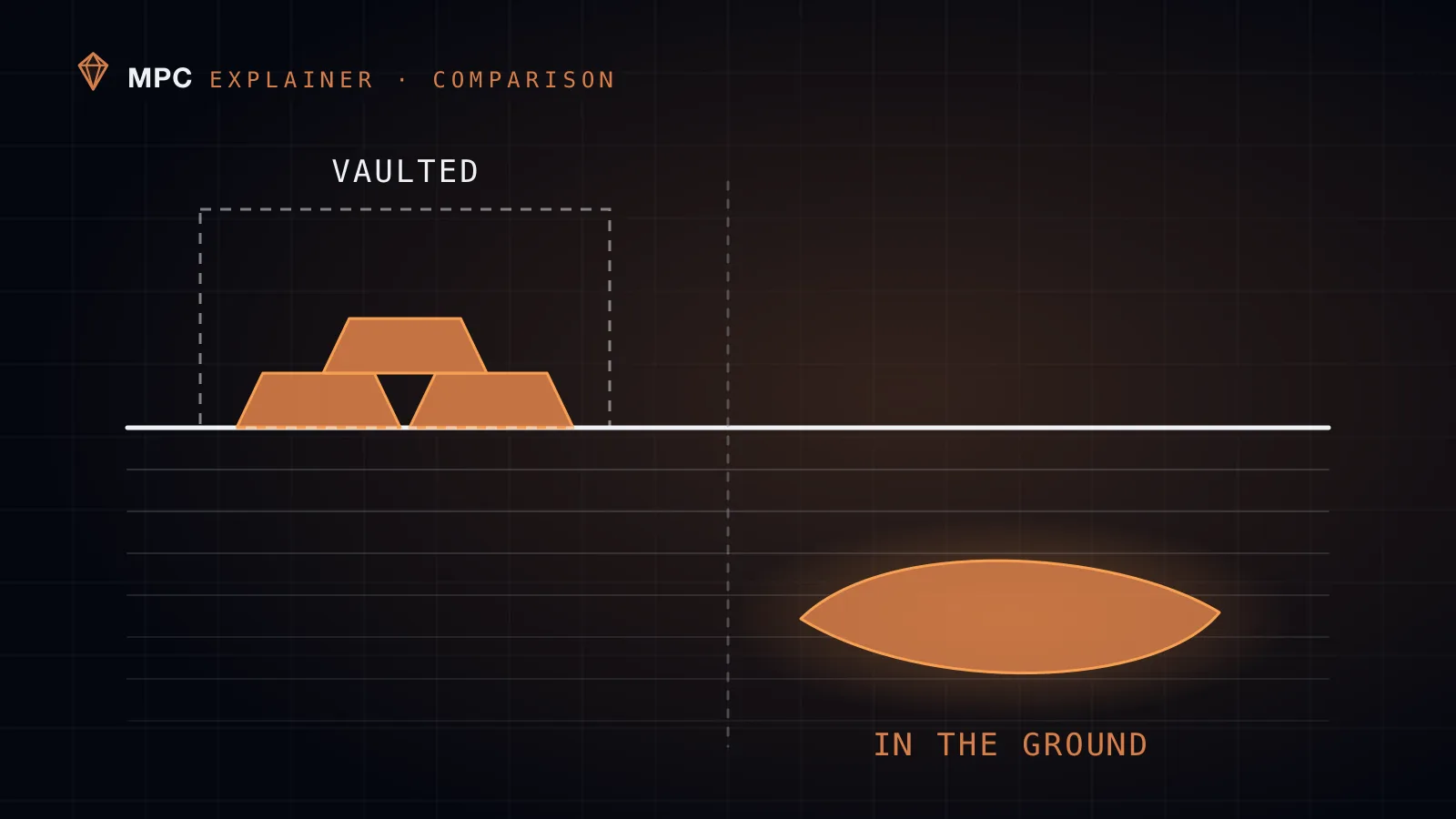
Tokenized gold such as PAXG and XAUT refers to physical bullion held in custody. In-ground gold tokens refer to mineral resources that remain underground, with different evidence, economics and legal rights. This guide compares backing, valuation, custody, redemption and risks, and explains where Global MPC's verification infrastructure fits in practice.
The short answer
Vaulted tokens link to refined bullion. In-ground tokens refer to mineralisation or a mineral resource that has not been extracted. The evidence, rights and redemption options differ.
| Comparison field | Vaulted tokenized gold | In-ground resource token |
|---|---|---|
| What backs it | Refined bullion allocated or identified under issuer terms | Contractual rights or exposure linked to mineral rights or a stated resource |
| Where the gold is | Refined, held in a disclosed vault or custody arrangement | Underground; not extracted or refined |
| Evidence | Bar records, custody records, reserve reports and assurance | Mineral rights, technical reports, resource classification and competent-person sign-off |
| Redemption | Cash, unallocated gold or physical bars, subject to terms, KYC, fees and minimums | Usually no bullion redemption; rights depend on the token contract |
| Main risks | Issuer, custodian, reserves, legal claim, liquidity and redemption | Geology, title, permits, recovery, costs, financing and legal rights |
| Typical regulation | Depends on issuer, jurisdiction and product classification | Depends on rights, offer, issuer, jurisdiction and product classification |
| Public examples | PAX Gold (PAXG), Tether Gold (XAUT) | NatGold, nGRND and I-ON Digital's IONau describe different models |
Issuer documents define the holder's claim; a geological report alone does not confer mineral ownership or bullion redemption.
What is tokenized gold?
Tokenized gold is a blockchain-based token whose terms are linked to physical gold held in custody. Depending on the issuer, each token may represent a fixed fine-weight claim or fractional beneficial ownership of allocated bullion. Holders rely on the issuer's legal terms, custody arrangements, reserve reporting, eligibility rules and redemption process; a wallet balance alone does not prove ownership rights.
PAX Gold (PAXG) and Tether Gold (XAUT) are prominent examples. Paxos says each PAXG represents one fine troy ounce of London Good Delivery gold and fractional beneficial ownership of allocated bars in segregated LBMA-approved vaults. Tether's 30 September 2026 reserves report says each XAUT represents one fine troy ounce held in Swiss vaults for token holders; BDO's reasonable-assurance report is dated 30 October 2026 and covers that reporting date.
How do PAXG and XAUT hold their gold? Both link tokens to identified bullion, but the contractual and redemption arrangements differ:
| Product | Published backing | Access and redemption |
|---|---|---|
| PAXG | Fractional beneficial ownership of allocated London Good Delivery bars in segregated LBMA-approved vaults; bar details and monthly attestation reporting. | Verified Paxos customers can convert to cash or unallocated gold. Physical-bar redemption requires at least 430 PAXG per bar, plus fees and delivery. |
| XAUT | One fine troy ounce per token; Swiss vault custody for token holders, per the September 2026 report. | Physical redemption is subject to eligibility, KYC, minimum bar quantities, fees and delivery in Switzerland. |
Under their published terms and dated reports, PAXG and XAUT are backed by identified bullion. Other gold tokens may have different custodians, claims and redemption rules, so any review should start with the contract and custody terms, then check reporting, access and redemption.
What is an in-ground resource token?
An in-ground resource token is a digital token whose legal or economic terms refer to an interest, exposure or participation right linked to mineral resources that remain underground. It does not represent refined bullion by default. The underlying evidence may include exploration results, a mineral resource estimate, mineral rights and technical reports, each with limits and different levels of confidence. Tokenizing In-Ground Mineral Resources compares the four models in use.
The holder's position depends on the instrument: a contractual economic interest, security, revenue participation, utility function or indirect ecosystem exposure. These are not interchangeable. Check the issuer, obligor, asset perimeter, enforcement route, transfer restrictions and events that may reduce or end the rights.
In-ground gold may mean mineralisation, an exploration target or a defined resource. These have different evidence thresholds, and none is automatically equivalent to refined bullion. For what a project needs to document before any tokenization, see What a Mining Project Needs Before Tokenization and Mining Asset Tokenization. For how tokenization compares with debt, equity, streaming and royalties, see Mine Financing Options and Where Tokenization Fits.
Evidence: custody attestation vs resource estimate
A custody attestation and a mineral resource estimate answer different questions.
For vaulted gold, custody attestation can include bar identification, custodian records, reconciliation of token supply to gold and independent assurance. Check the date, assurance standard, procedures, exceptions, custodian and token population. A report is point-in-time evidence, not a guarantee against later changes or all issuer risks.
Paxos publishes monthly attestation information and bar allocations. Tether's September 2026 report describes its one-ounce-per-token position and Swiss custody. Review the Paxos PAXG terms, PAXG reporting information and Tether Gold terms.
For an in-ground asset, evidence may include mineral tenure, mapping, sampling, assays, drilling, QA/QC, a technical report and classification under JORC or NI 43-101. Check the competent or qualified person, effective date, source data and assumptions. A resource estimate is a technical classification, not proof of profitable extraction.
Proof of reserve for vaulted bullion concerns custody and quantity. An ore or mineral resource report concerns geological evidence and prospects for eventual extraction. Neither replaces the other. Proof of Reserves vs Ore Reserve explains the two terms.
What critics of in-ground tokens say
The main criticism is that promotional language can make unmined mineralisation sound economically equivalent to refined gold. That skips title, resource definition, permits, engineering, financing, recovery, processing and delivery.
On 2 November 2026, the BC Securities Commission published "Fool's Gold: Crypto Tokens Backed by Purported Mineral Deposits". It warned that a technical report alone does not establish economic value. Without an assessment of extraction viability or a plan to mine, the material may not qualify as a mineral resource. It also cautioned against suggesting that tokens linked to unmined deposits have rights or value comparable to recovered gold. The warning addresses the promotional practices it describes, not every possible contractual model involving a mineral project.
An estimated underground ounce is not the same as an ounce of refined gold multiplied by the spot price. Grade, recovery, mine design, capital and operating costs, royalties, permits, taxes, closure, timing and development probability affect value. Spot gold is a reference for refined metal, not the price payable today for every estimated underground ounce.
Models also differ. NatGold's terms describe an economic interest referencing certified in-ground resources, while disclaiming direct title to mineral rights or possession of mined gold. nGRND describes NGRND as a utility token with economic exposure, but says holders own no gold or mineral interest and have no physical redemption right. I-ON Digital describes IONau as a digital instrument linked to interests in economically viable in-ground gold reserves and supported by contractual rights. Review each issuer's current terms and filings. NatGold vs MPC compares NatGold with Global MPC field by field. The Mining RWA Registry lists these and other projects on the same fields.
Whether an in-ground gold token is safe has no universal answer. Assess the issuer, rights, geological evidence, valuation, counterparties, transfer controls and regulatory status.
Market size, with source and date
CoinGecko's Tokenized Gold category showed about US$5.39 billion in aggregate market capitalization and about US$289 million in 24-hour trading volume when checked on 14 November 2026.
This snapshot changes with prices, supply and category methodology. It covers tracked vaulted-gold tokens, not every gold token; other gold token structures fall outside this category.
The cited category provides no equivalent standardised market-cap figure for in-ground resource tokens. Projects disclose different structures, and some tokens are utility or participation assets rather than direct mineral claims. Their valuations should not be added to bullion-token market capitalization as though the products were equivalent.
Where Global MPC fits
Global MPC is neither a vaulted-gold issuer nor an in-ground gold token issuer. It is building verification and registry infrastructure for mining project data, including source records, professional review and digital registry functions. This infrastructure organises evidence; it does not create mineral or bullion ownership.
MPC's public disclosures state that $MPC has not been issued and remains at the Pre-TGE stage. MPC Unity operates separately, and the Registry dApp remains in development. Holding $MPC, if issued, conveys no equity, fractional ownership of minerals or claim to mining revenue. Project-level asset issuers define their own rights.
The Mining RWA Registry article lists 12 projects on the same fields, each with its source; the Registry dApp itself remains in development. The limits of on-chain verification guide explains that a proof can show registry inclusion and whether a record changed, but cannot prove the truth, value or legal effect of a document. See also Mining Asset Tokenization.
FAQs
What is tokenized gold?
Tokenized gold is a digital token backed by refined physical gold held in custody, such as PAX Gold (PAXG) or Tether Gold (XAUT). What a holder can claim depends on the issuer's terms.
What is an in-ground gold token?
It is a token that refers to gold still in the ground, based on a geological estimate. The gold has not been mined or refined.
Which is lower risk?
They carry different risks. Vaulted gold tokens depend on custody and the issuer. In-ground tokens add geological, permitting, cost and legal uncertainty. This page does not recommend either.
Is in-ground gold worth the same as vaulted gold?
No. Gold in the ground must be found, proved, permitted, mined and refined before it is bullion. The BC Securities Commission has warned against presenting tokens linked to unmined deposits as comparable to recovered gold.
Where does Global MPC fit?
Global MPC is neither. It is building verification and registry infrastructure for mining project data. $MPC has not been issued, remains at the Pre-TGE stage and conveys no ownership of minerals.
MPC Team, globalMPC
November 18, 2026