
Mining Asset Tokenization: From Verified Project to On-Chain Record
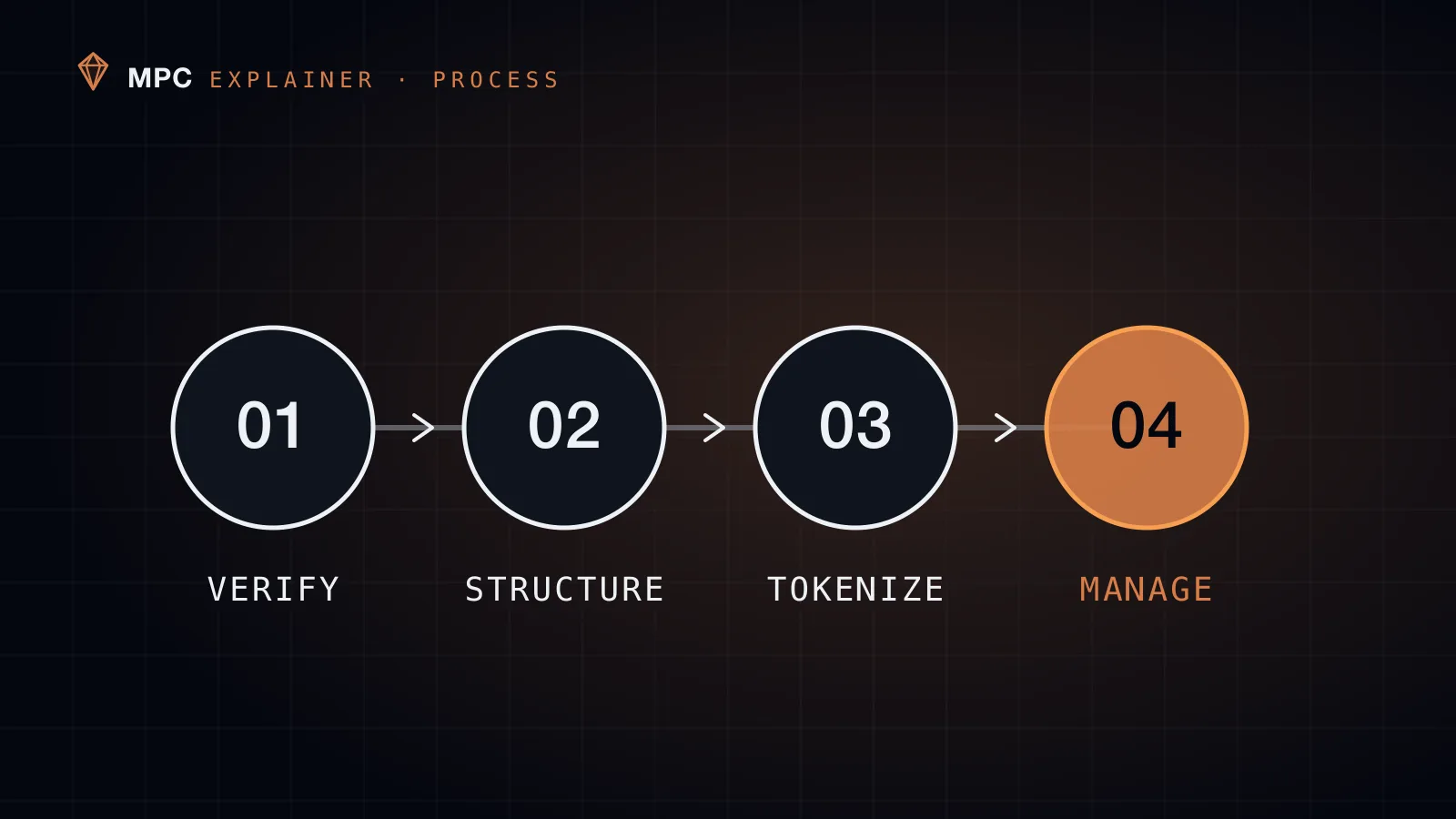
Mining asset tokenization turns mining project evidence and legally defined rights into structured digital records that can support potential on-chain issuance. Global MPC connects project data, professional verification, asset structuring and lifecycle management through a four-step framework. Token issuance depends on legal, technical and regulatory conditions; $MPC remains at the pre-TGE stage.
What is mining asset tokenization?
Mining asset tokenization is the process of organising information and legally defined rights associated with a physical mining project, then connecting eligible assets or interests to digital tokens on a blockchain. It begins with project identification, evidence collection and professional verification, followed by structured digital records and potential on-chain issuance. The resulting tokens represent rights defined by their legal and asset structure, not automatically ownership of physical minerals.
The process begins with the underlying mining project, not the blockchain. Geological information, exploration records, licences, technical reports and other supporting documents establish the evidence base. Once reviewed and structured, eligible project information can connect to digital asset infrastructure.
This process belongs to the broader real world asset tokenization market, where physical assets and legally defined interests are represented through blockchain-based systems. Mining introduces specific requirements because geological evidence, mineral rights, exploration activities and project development stages all influence how an asset can be represented.
Why mining needs it
Mining projects involve substantial amounts of technical, geological, operational and legal information. Exploration data may come from different field teams, laboratories, technical consultants and government authorities. Ownership and licensing documentation can also involve several entities and jurisdictions.
For institutions evaluating mining opportunities, fragmented information creates difficulties during due diligence. Reviewing individual reports without a consistent record structure can make it harder to establish the origin of information, identify document changes and understand who verified particular findings.
This creates an opportunity for mining-focused RWA infrastructure.
At a broader level, RWA tokenization provides a framework for connecting physical assets with digital records. However, applying this concept to mining requires an approach that accounts for the technical nature of mineral projects. A mining RWA system must consider geological evidence, professional verification, asset rights and project-specific legal requirements.
Global MPC is developing its infrastructure to address this gap. Its objective is to connect real mining projects with professional verification, structured information, digital registries, Oracle/API services and enterprise applications.
The platform is designed to make project information more organised and traceable, providing a consistent foundation for subsequent institutional assessment and potential asset issuance.
Explore the underlying industry challenges in the MPC Industry Problem documentation.
A mining-focused RWA tokenization platform needs to connect more than a token contract to a blockchain. It needs to establish how the underlying project is identified, how supporting evidence is reviewed, how rights are structured and how records remain accessible throughout the asset lifecycle.
This is the distinction between a general tokenization platform and infrastructure designed specifically for physical mining projects.
How it works: Verify, Structure, Tokenize, Manage
Global MPC approaches mining asset tokenization through four connected stages. The framework follows the progression of a physical mining project from its original documentation to structured digital records and potential on-chain applications.
1. Verify: Establish the underlying evidence
Every mining project begins with physical information and supporting documentation.
This can include:
- Exploration and geological records.
- Drilling and sampling information.
- Laboratory results and assay certificates.
- Mining licences and relevant legal documentation.
- Existing technical assessments and reports.
These materials are reviewed by qualified professionals, competent persons, technical experts, laboratories or relevant institutions within their respective areas of responsibility.
The objective is to establish the provenance and verification status of the information. Each review should identify its source, scope, responsible party, methodology and limitations.
Global MPC's approach does not replace professional judgement. Instead, the infrastructure connects project information with the relevant verification records.
The MPC Solution chapter of the whitepaper describes this component in more detail.
2. Structure: Convert project information into digital records
After the relevant evidence has been collected and reviewed, information is organised into consistent digital records.
This stage establishes relationships between the original source documents, verification results, responsible parties and subsequent updates.
The MPC structure is designed around several important components:
- Source: Original project information and its provenance.
- Verification: The reviewing party, methodology and status.
- Integrity: Hash references and timestamps.
- Version: Changes and updates to project information.
- Registry: Connections between projects, verification records and associated assets.
These components provide a traceable data structure that can support institutional assessment and subsequent asset structuring.
The MPC Platform Architecture explains how the five infrastructure layers connect real-world project information with verification, data services, asset infrastructure and applications.
3. Tokenize: Connect eligible assets to blockchain infrastructure
Once project information has been verified and structured, an eligible mining project can progress toward digital asset representation.
This requires a legally defined asset structure that establishes what a digital token represents, including associated rights, obligations, ownership arrangements and transfer conditions.
The process may involve:
- An appropriately identified mining project.
- Verified and structured project information.
- A defined legal and asset structure.
- Relevant smart contracts and registry infrastructure.
- Potential on-chain asset issuance.
The Mineral Project Coin ($MPC) utility token is designed for BNB Smart Chain. The network and implementation for any asset token depend on that asset's technical and legal structure.
$MPC remains at the pre-TGE stage. The Registry dApp and its core on-chain verification components remain in development. Describing the intended tokenization architecture does not mean that mining assets or the $MPC token have already been issued on-chain.
A real world asset tokenization platform must also distinguish between representing project information and issuing a legally recognised financial interest. These are related but separate processes.
This is why mining tokenization requires coordination between technical infrastructure, professional verification and appropriate legal structuring.
4. Manage: Maintain records throughout the asset lifecycle
Mining projects evolve. Exploration activities generate additional data, drilling programmes produce new results, licences may change and operational milestones introduce new documentation.
A digital record system therefore needs to accommodate updates rather than treating tokenization as a single transaction.
MPC's planned Registry infrastructure is designed to maintain project records, verification history, document versions and integrity references over time.
This creates a foundation for connecting mining companies, professional reviewers, asset issuers and authorised institutional users through digital applications, APIs and other infrastructure services.
The complete framework is explained in How MPC Works.
Mining asset tokenization vs tokenized gold vs crypto mining
Although these concepts can appear together in cryptocurrency and RWA searches, they describe different activities.
| Category | Mining Asset Tokenization | Tokenized Gold | Crypto Mining |
|---|---|---|---|
| Underlying subject | Physical mining projects and associated rights | Physical gold or legally defined gold interests | Computing hardware and blockchain infrastructure |
| Starting point | Mining project information and technical evidence | Refined gold or gold held in storage | Computing resources and mining equipment |
| Main activity | Verify, structure and potentially tokenize mining assets | Create digital representations of gold holdings or associated rights | Validate transactions or support proof-of-work networks |
| Evidence requirements | Geological data, licences, technical reports and verification records | Custody records, gold quantity, quality and ownership documentation | Hardware, computing output and network participation |
| Main considerations | Asset rights, geological risks, professional verification and regulation | Custody, redemption, counterparty and issuer risks | Electricity costs, hardware, network difficulty and profitability |
Can a gold mine be tokenized?
Yes, potentially. However, the specific structure determines what the token represents.
A gold mine is a physical mining project involving exploration, mineral information, licences, operational activities and potentially future production. A tokenized gold product generally relates to refined gold held in custody or a legally defined interest in that gold.
Mining asset tokenization starts with the mining project and its supporting evidence. Tokenized gold usually starts with an identifiable quantity of refined metal and its custody arrangements. They therefore involve different verification requirements, asset structures and risk considerations. Tokenized Gold vs In-Ground Resource Tokens compares the two in detail.
Is it the same as crypto mining?
No. Crypto mining generally refers to computational activities associated with proof-of-work blockchain networks. Mining asset tokenization concerns physical mineral and metal projects.
The same distinction applies to tokenized commodities more broadly. They can include gold, metals and other physical resources, but their token structures and underlying evidence requirements vary.
Who it is for
Global MPC's infrastructure is designed for participants across the physical mining and digital asset ecosystems, in two groups: mine operators and institutions.
Mine operators
The infrastructure is designed to help mining companies, exploration operators, mineral rights holders and project sponsors organise project information and prepare available evidence for professional review.
The objective is to establish a structured documentation foundation that may support future institutional assessment and potential asset tokenization.
For operators exploring how to tokenize their mining projects, the starting point is the available project data and supporting technical documentation.
The records a project should prepare are listed in What a Mining Project Needs Before Tokenization. Financing routes and a readiness checklist are in Mine Financing Options and Where Tokenization Fits.
Institutions
Investment firms, asset managers, family offices and financial institutions require reliable information before evaluating exposure to physical mining assets.
Global MPC's approach focuses on providing structured project records, traceable verification references and supporting digital infrastructure.
For institutions, the distinction between technical infrastructure and the legal rights represented by an issued instrument is particularly important.
Institutions can explore the platform's architecture, documentation and risk framework before considering any potential participation.
Tokenized Mining Assets for Institutions sets out what institutions can review and how to request the institutional review brief.
Risks and limits
Tokenized mining projects carry risk in both the physical asset and the digital infrastructure connected to it:
- Underlying asset risk: Geological information, mineral estimates, exploration results and production assumptions can change as additional work is completed. Digital records do not eliminate geological uncertainty.
- Verification risk: A verification record establishes that a defined review took place within a stated scope. Its existence does not automatically establish that every underlying claim is accurate or that an asset is commercially viable.
- Legal and ownership risk: A token does not automatically convey ownership of land, mineral rights, mining licences or future production. The associated rights must be established through the appropriate legal agreements and asset structure.
- Technology risk: Smart contracts, APIs, data connections, oracles and digital registries can introduce technical vulnerabilities, operational failures and cybersecurity exposure.
- Market and regulatory risk: Token liquidity, asset valuation, investor eligibility, regulatory classification and cross-border distribution depend on the particular offering and applicable jurisdiction.
Global MPC explicitly distinguishes verification from a guarantee. Its dApp verification limitations explain what on-chain proofs can establish and what they cannot establish about the underlying information.
The official disclosures provide additional information about the project's development stage, token status, risk factors and legal limitations.
As of 17 November 2026, $MPC remains at the pre-TGE stage. No issued token contract or completed Registry on-chain verification deployment should be assumed.
Reference case: Tsagaan Tolgoi
Tsagaan Tolgoi, Mongolia, is Global MPC's first mining reference case. It demonstrates how physical exploration activities and supporting project documentation can be organised within the proposed mining RWA infrastructure framework.
The project is at the exploration stage. Its records include geological observations, drilling information, sample collection and laboratory documentation.
The reference case provides an opportunity to understand the relationship between physical mining information, technical evidence and structured digital records.
However, Tsagaan Tolgoi should not be interpreted as a completed mining asset tokenization or commercial production project. Its exploration licence is held by an independent licence holder. Commercial production has not started, and no JORC- or other CRIRSCO-compliant mineral resource or reserve report has been issued.
Explore the Tsagaan Tolgoi reference case to review the project's published information and supporting materials.
FAQs
What is mining asset tokenization?
Mining asset tokenization converts verified mining project data into structured digital records that can support potential on-chain issuance. The process connects physical project information, professional verification and legally defined asset rights with blockchain-based digital representations.
How does mining asset tokenization work with Global MPC?
Global MPC follows four stages: Verify the project data, Structure it into digital records, Tokenize eligible assets for potential on-chain issuance, then Manage the associated records over time. Each stage depends on the necessary technical, legal and regulatory requirements. The $MPC utility token is designed for BNB Smart Chain and remains pre-TGE.
Is mining asset tokenization the same as crypto mining?
No. Mining asset tokenization concerns physical mining projects, including mineral deposits, exploration activities and associated rights. Crypto mining refers to computational processes used by certain blockchain networks to validate transactions and maintain network security.
How is it different from tokenized gold?
Tokenized gold generally represents refined gold held in storage or a legally defined interest in that metal. Mining asset tokenization starts earlier, with the physical mining project, its exploration information, technical documentation and associated rights. The two applications therefore have different evidence, custody and asset structuring requirements.
MPC Team, globalMPC
November 18, 2026