
Offtake vs Royalty vs Streaming in Mining
An offtake commits a buyer to a mine's future output, often before it is built. How offtake, royalty, streaming and tokenization compare, with an example.
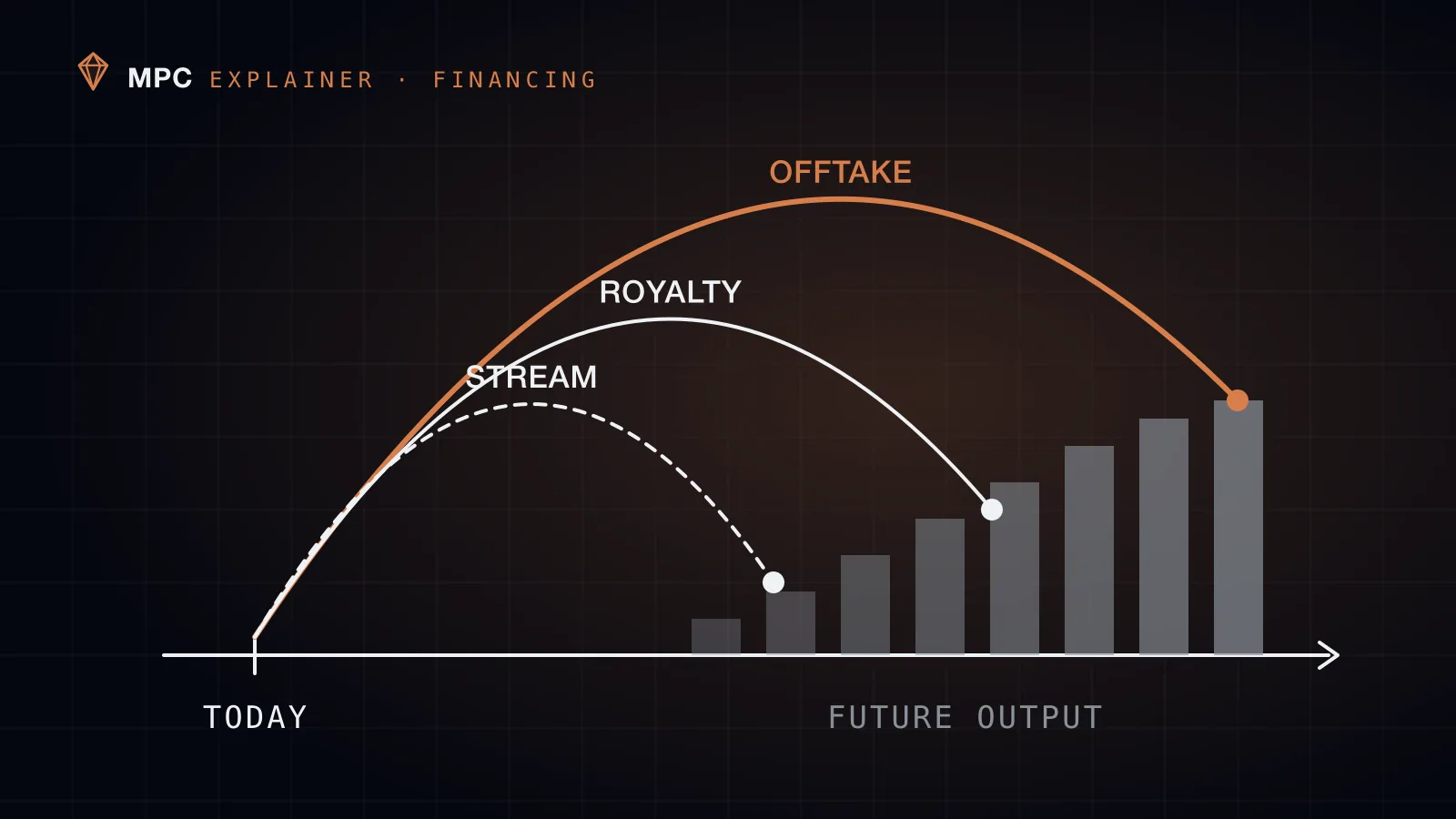
An offtake agreement gives a mine a committed buyer for specified future production and can support project financing before construction. This guide explains the offtaker, the main contract terms, royalties, streaming and tokenization, then compares them through one illustrative gold-mine example. For a wider view of debt, equity and other financing routes, see Mine Financing Options and Tokenization.
What is an offtake agreement?
An offtake agreement is a contract between a producer and a buyer, known as the offtaker, under which the buyer commits to purchase a defined quantity or share of future output. In mining, it may cover concentrate, ore or refined metal and is often negotiated before construction to support market access and project financing, under agreed quality and delivery specifications.
The offtaker may be a smelter, refinery, commodity trader, processor or manufacturer. It buys a defined product under agreed conditions, and the mine must deliver material that meets specifications. In practice, an offtake is a sales commitment over future output.
The term is sometimes used loosely. A signed offtake contract contains enforceable obligations; an expression of interest or a non-binding term sheet may not commit a buyer.
How does an offtake support mine finance?
A mine may negotiate offtake agreements before construction to establish a route to market and reduce sales uncertainty. A committed buyer can help lenders assess expected revenue, demand and counterparty credit, particularly for commodities with few qualified buyers or specialised processing.
Offtake financing may include a buyer prepayment or advance against future deliveries. The mine receives cash earlier and repays it through shipment deductions or another contractual mechanism. That can fund construction or working capital, but reduces cash received from later deliveries.
An offtake alone does not make a project bankable. Lenders also assess permits, studies, production forecasts, costs, construction risk and buyer performance. The value of an offtake depends on enforceability, volume, pricing, tenor, buyer credit and termination terms, and it should be reviewed alongside independent technical and legal due diligence. It is one part of a financing package, not a replacement for it.
Key terms in an offtake
The contract must turn the production plan and the buyer's requirements into measurable obligations. Five commercial terms need particular attention:
- Volume: whether the buyer takes all output, a percentage or a fixed quantity, including minimums, maximums, ramp-up, shortfalls and make-up rights.
- Pricing formula: the benchmark, quotation period, currency, premium or discount, treatment and refining charges, penalties, by-product credits and provisional settlement.
- Tenor: the start date, duration, renewal rights and relationship to commissioning and mine life. Long terms can help financing while limiting future sales flexibility.
- Take-or-pay: whether the buyer must pay for a minimum volume even if it does not take delivery, with exceptions and make-up rights. This allocates demand risk differently from payment only on accepted delivery.
- Delivery point: title and risk transfer, transport, insurance, shipment windows, weighing, sampling and assay procedures.
The contract should also cover product quality, rejection, payment, credit support, guarantees, force majeure, default, termination, audit rights and disputes, and distinguish a production shortfall from seller default, including delayed or off-spec shipments and a buyer unable to receive material.
Royalties explained
A net smelter return (NSR) royalty gives its holder a stated percentage of revenue from mineral products after specified smelting, refining, transport or other agreed deductions. The contract defines the revenue basis, permitted deductions, reporting period and payment date. It is calculated from sales proceeds, not from the mine's net profit.
The royalty holder normally receives cash based on the defined revenue calculation, rather than taking physical delivery or controlling operations. The list of deductions is contractual: some agreements exclude mining costs, corporate overhead or capital expenditure. The rate, audit rights, reporting and payment timetable should be explicit, and anyone evaluating an NSR royalty should model how the deduction wording changes payments under different prices and production levels.
A royalty can provide upfront capital in exchange for a long-term interest in project economics, and it may affect a later sale or refinancing.
Streaming explained
A streaming agreement provides an upfront deposit or purchase prepayment to a miner in exchange for the right to buy an agreed share of future metal production. On delivery, the streamer pays a further contractual amount per unit, commonly below market price. The stream is usually tied to particular metals and production, and sets duration, delivery rules and remedies.
In precious metals streaming, a specialist financier usually advances capital for the right to buy an agreed share of future gold or silver at a set ongoing price, sometimes linked to spot. The streamer takes delivery and can resell the metal. The mine receives upfront funding but commits future production at the stream's agreed economics.
Stream financing can be staged against development milestones. The contract should identify the metal, share or quantity, payment amount, delivery schedule, start date, duration and remedies for underproduction. The mine gives up some future price upside on streamed units, and the streamer bears resale price exposure after delivery. The economic cost must be assessed over the full term, not from the deposit alone. Streams over by-product gold or silver are common.
Offtake vs royalty vs stream vs tokenization
The structures serve different purposes. An offtake is mainly a sales arrangement. A royalty or stream exchanges capital for a future economic entitlement. Tokenization represents rights that must already be defined in legal documents; it is not a financing product by itself.
| Dimension | Offtake | Royalty | Stream | Tokenization |
|---|---|---|---|---|
| What is received | Right to buy defined output | Share of defined revenue or production | Right to buy specified future metal at an agreed ongoing price | Digital representation of a legally defined right, such as debt, equity or a royalty |
| Upfront capital | Usually none; prepayment can be added | Often paid upfront for the royalty | Commonly an upfront deposit or prepayment | Depends on the underlying offering; the token format alone raises no capital |
| Dilution | No equity dilution by itself | Usually no share dilution, but encumbers project economics | Usually no share dilution, but commits future metal | Depends on the underlying legal instrument |
| Price risk | Allocated by benchmark and pricing formula | Holder's receipts move with the defined revenue base | Streamer has resale exposure; miner gives up upside on streamed units | Determined by the rights represented |
| Typical stage | Often pre-construction or before production | Exploration through production | Development, construction or expansion | Depends on legal structuring and project readiness |
| Disclosure needed | Volume, price formula, tenor, buyer credit and delivery | Rate, revenue base, deductions, term and payment rights | Deposit, metal share, ongoing price, term and delivery | Issuer, rights, risks, transfer rules, servicing and holder protections |
An offtake with a prepayment can have financing features while remaining a purchase contract. The offtaker buys product under the agreed pricing formula; a streamer advances capital for the right to buy future metal at a specified ongoing price.
Tokenization cannot create a buyer, solve logistics or provide a guaranteed sales route, so it does not replace an offtake. Where it is used, the issuer must define the rights, investor eligibility, governance, servicing and transfer rules. Mine Financing Options and Tokenization covers where tokenization fits among financing routes.
A worked example
This fictional example is illustrative only. It is not an offer, a valuation or an MPC transaction. Assume a gold mine produces 10,000 payable ounces a year for ten years, at an assumed reference price of US$2,000 per ounce. Taxes, operating costs, discount rates, hedging and price changes are ignored so the structures can be compared on the same production base.
- Offtake: a buyer purchases 80% of annual output, or 8,000 ounces, at the reference price less negotiated charges. This gives a defined sales route but no construction cash unless the buyer also prepays. If the buyer advances US$5 million, the contract must state how shipment payments repay the advance and what happens if production is delayed.
- Royalty: under a 2% NSR royalty, an investor provides upfront capital for 2% of defined net smelter returns. If illustrative NSR is US$19.8 million after permitted deductions, the annual royalty is US$396,000. Actual payments depend on the contract's revenue definition, eligible production and deductions, not mine profit.
- Stream: an investor pays a US$8 million deposit for the right to buy 10% of annual production, or 1,000 ounces, at US$400 per ounce. The mine receives US$400,000 for those ounces on delivery, while the streamer's gross price difference at the reference price is US$1.6 million a year before costs. This is not the streamer's investment return; the deposit, duration, risk and time value must also be modelled.
- Tokenization: the same 2% NSR right could, where the law allows and after legal review, be represented by digital tokens. The underlying payment would be the same as in the royalty case. Tokenization may change how ownership, investor access, reporting or transfers are administered. It does not create extra production or guarantee liquidity.
Upfront capital alone is an incomplete comparison. Full-life obligations, production exposure, deductions, buyer credit and price upside all need to be modelled.
Where verified project data fits
An offtaker or financier may ask for technical reports, resource and reserve disclosures, production plans, permits, title, product specifications, assay records, environmental data, logistics and ownership details. Verified evidence should be kept separate from estimates, historic records and information still awaiting review.
MPC's ecosystem chapter describes mining companies as providers of project data, verification partners as providers of professional review, and enterprises and institutions as users of data and infrastructure. The business model chapter covers project onboarding, verification, data and registry, asset issuance infrastructure and lifecycle management. How MPC Works shows the five layers, from real-world records through verification, data and oracle services, asset infrastructure and applications.
This infrastructure, which MPC is building, is designed to help organise records relevant to diligence. It does not negotiate an offtake, certify buyer performance, determine bankability or replace independent technical and legal review. What a Mining Project Needs Before Tokenization lists the documents a project typically gathers, and operators can submit a project for initial screening.
FAQs
What is an offtake agreement?
A contract in which a buyer agrees to purchase all or part of a producer's future output. In mining it is often signed before a mine is built and can help the project raise finance.
Who is the offtaker?
The buyer in the agreement, for example a smelter, trader or manufacturer.
How is an offtake different from a stream or a royalty?
An offtake is a sales contract at an agreed pricing formula. A stream is an upfront payment for the right to buy a share of future metal at an agreed ongoing price, usually below market. A royalty is a right to a percentage of revenue or production.
What is a net smelter return royalty?
A net smelter return (NSR) royalty pays its holder a percentage of the revenue a mine receives from the smelter or refinery, after defined deductions.
How does tokenization relate to offtake?
Tokenization does not replace an offtake. Structured, verified project records can sit alongside offtake, royalty or stream finance, and any token structure is subject to legal review.
MPC Team, globalMPC
November 18, 2026