
ESG and Critical Minerals Provenance: What a Blockchain Record Can and Cannot Prove
Conflict minerals rules, battery passports, IRMA and Veramark explained. A blockchain record shows who signed what and when, not that it is true.
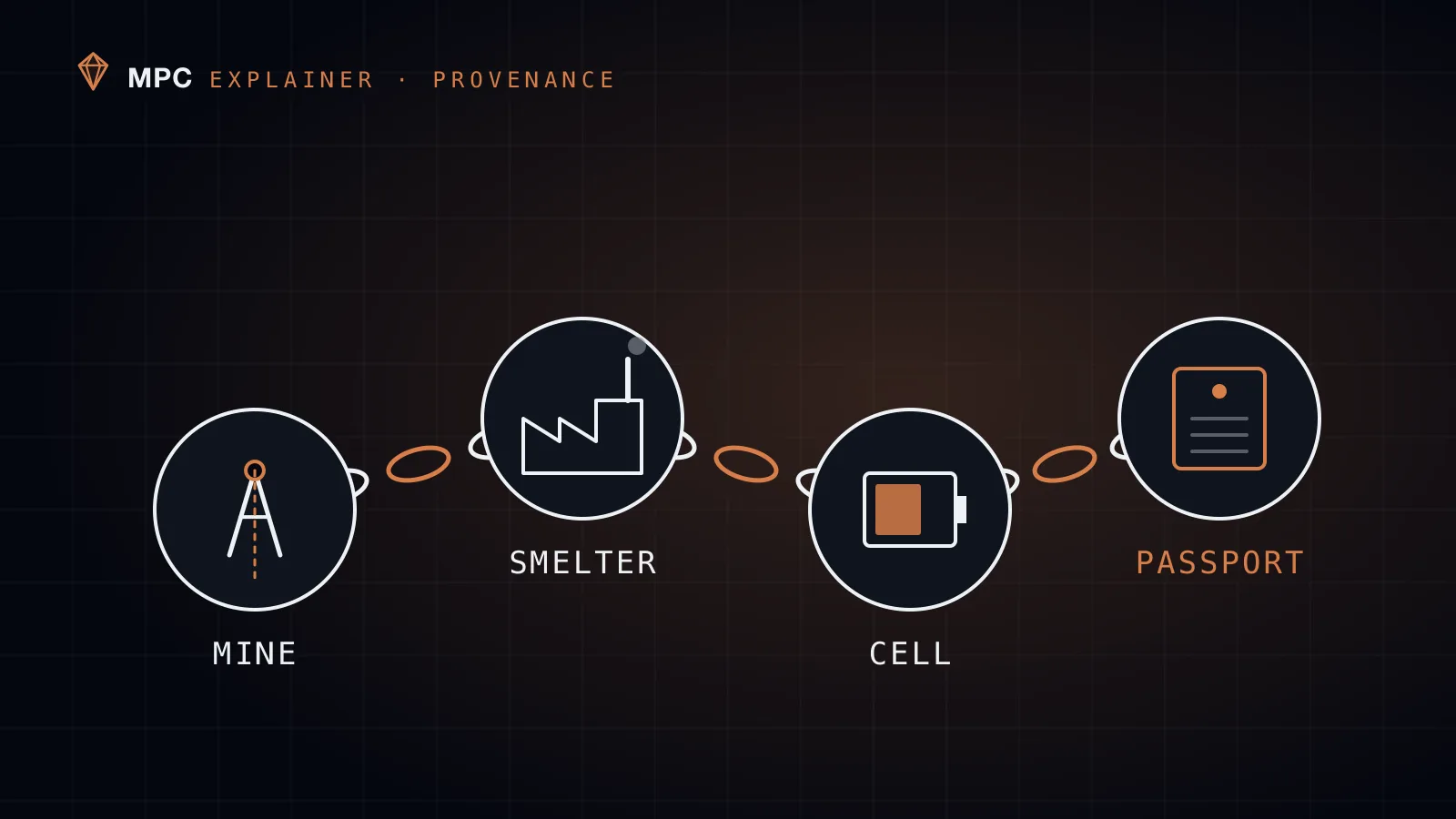
Mineral provenance records a mineral's origin, custody and movement through extraction, processing and trade. Critical minerals rules, conflict-minerals due diligence, battery passports and voluntary standards create evidence requirements. Blockchain can preserve signed records, timestamps and document hashes, but audits and site checks remain necessary to assess whether claims are accurate.
What is mineral provenance?
Mineral provenance is the documented history of a mineral's origin, custody and handling as it moves from extraction through processing, trading and delivery. It links each material or batch to source records, responsible parties, dates and transformations. Provenance helps buyers assess origin and risk, but its reliability depends on the quality and independent checking of those records for each material.
A useful record identifies the mine or source, licence, operator, material or lot, custody transfers, processing steps, dates and receiving facility. It distinguishes direct observations from supplier declarations and independent checks. A chain-of-custody record follows the parties handling a material; traceability links those events to a batch or product.
Provenance alone does not establish environmental or social performance. A documented route can still involve unsafe work, pollution, land disputes or human-rights abuses. ESG reviews of mining supply chains therefore combine origin records with risk assessment, stakeholder engagement, mitigation and remedy.
How can mineral provenance be verified? By comparing source documents, physical records and custody events, then independently checking material claims.
Why critical minerals raise the stakes
Critical minerals support technologies across electricity networks, batteries, semiconductors, defence, transport and manufacturing. Their supply chains may depend on a small number of extraction or processing locations, creating exposure to export controls, conflict, environmental harm, labour abuse and disruptions.
The label "critical" is jurisdiction-specific. It reflects a government's assessment of economic importance, strategic need and supply risk, and does not itself certify a project as responsible.
The United States, United Kingdom and European Union publish separate lists:
| Jurisdiction | Current reference | Purpose |
|---|---|---|
| United States | USGS 2025 List of Critical Minerals: 60 minerals | Assesses economic or national-security importance and supply disruption risk. |
| United Kingdom | Vision 2035 and its technical annex, using the 2024 Criticality Assessment | Supports supply-security and industrial policy, with separate critical and growth minerals lists. |
| European Union | Critical Raw Materials Act: 34 critical raw materials, including 17 strategic raw materials | Sets priorities for extraction, processing, recycling and supply diversification. |
The USGS 2025 list includes copper, lithium, cobalt, graphite, rare earth elements, uranium, tin, tantalum and tungsten.
The UK Vision 2035 strategy sets out a plan to 2035 for domestic production, processing, recycling and international partnerships. Its annex separates critical minerals from growth minerals. Copper, for example, is a UK growth mineral, not a critical mineral.
The EU Critical Raw Materials Act sets its own list of 34 critical materials, 17 of which are strategic.
These lists are distinct from conflict-minerals rules. A rare earth supply chain may be strategically critical because processing is concentrated, while a 3TG supply chain may trigger origin and due-diligence requirements linked to conflict risks.
Critical minerals sourcing decisions therefore need supply-security analysis alongside project-level environmental, social and governance evidence. The UK strategy is policy, not a substitute for jurisdiction-specific regulatory analysis.
The rules: conflict minerals and due diligence
The phrase conflict minerals commonly refers to tin, tantalum, tungsten and gold, grouped as 3TG. Their extraction and trade can be associated with armed groups and serious human-rights abuses in conflict-affected and high-risk areas.
The definition needs a jurisdictional caveat: the US and EU frameworks cover similar minerals, but their entities, geographic tests and reporting duties differ.
In the United States, Section 1502 of the Dodd-Frank Act and SEC Rule 13p-1 require certain SEC-reporting issuers to conduct a reasonable country-of-origin inquiry when 3TG is necessary to the functionality or production of a product they manufacture or contract to manufacture.
The inquiry concerns origin in the Democratic Republic of the Congo or an adjoining country, or recycled and scrap sources. Where the rule's conditions are met, issuers conduct due diligence and disclose through Form SD, with a Conflict Minerals Report where required.
The rule is not a ban on 3TG and does not apply identically to every mine or trader. See the SEC rule and compliance guide.
In the EU, Regulation (EU) 2017/821 applies due-diligence duties to covered Union importers of tin, tantalum, tungsten and gold from conflict-affected and high-risk areas, subject to product and volume thresholds.
Requirements include management systems, risk management, independent audits and public reporting. It has applied since 1 January 2021. Consult the official EU text for the precise scope.
The OECD Due Diligence Guidance is broader. Its five-step framework covers management systems, risk identification and assessment, response, independent third-party audits at identified points, and public reporting.
It is guidance, not a universal certificate, and can be applied to minerals beyond 3TG. See the OECD guidance and its five-step framework.
This distinction between conflict minerals regulation and wider ESG expectations matters. A filing can meet a defined disclosure duty without demonstrating strong water management, safe tailings, fair labour or effective community engagement.
Responsible sourcing requires evidence matched to each legal duty and risk, alongside continuing prevention, mitigation and remedy.
Product passports: the EU battery passport and digital product passport
A battery passport is a digital record linked to a particular battery, normally accessed through a QR code. Depending on category and applicable rules, it can include battery identity, technical characteristics, manufacturer details, performance, durability, repair, reuse, recycling and sustainability information.
From 18 February 2027, the EU Batteries Regulation requires a passport for each light means of transport battery, industrial battery above 2 kWh and electric-vehicle battery placed on the EU market or put into service.
The responsible economic operator is the one placing the finished battery on the market, not every supplier of a component. See the Commission's battery passport guidance and Article 77.
Who needs one? The passport is a record for specified battery categories, maintained by the economic operator placing the finished battery on the EU market. Mining suppliers may have to provide upstream data, but are not automatically the passport issuer.
The wider digital product passport framework sits under the Ecodesign for Sustainable Products Regulation. Product-specific rules arrive through delegated acts or separate legislation. It is not yet a universal passport obligation for every raw material or product.
Voluntary standards compared
Voluntary standards and assurance schemes cover different parts of a mineral value chain. A mine-site assessment, refiner audit and supply-chain due-diligence assessment are not interchangeable.
| Standard or scheme | Scope | Who audits or assesses | What is public |
|---|---|---|---|
| IRMA (Initiative for Responsible Mining Assurance) | Mine-site social and environmental performance. Current v1.0 applies to operating industrial mines and co-located processing, not exploration or stand-alone processing. | IRMA-approved independent third-party audit firms. | Detailed audit reports, status and achievement levels. |
| Veramark Assurance (formerly the Copper Mark) | Site-level responsible production and sourcing. Its marks cover relevant copper, molybdenum, nickel and zinc operations. | Approved independent third-party assessors. | Participant status, performance determinations and assessment summaries. |
| Responsible Minerals Initiative (RMI) | RMAP assesses smelter and refiner management systems and sourcing practices. It is not a mine-site ESG certification. | Independent third-party assessors under RMI's process. | Public facility lists identify participating, active and conformant facilities. |
| LBMA Responsible Gold Guidance | Gold-refiner supply-chain due diligence, including origin and counterparty risks. | LBMA-approved independent assurance providers, with annual assurance for refiners. | Public compliance and assurance reports; some country-of-origin and management material remains confidential. |
The current IRMA Standard v1.0 contains more than 420 auditable requirements across business integrity, planning for positive legacies, social responsibility and environmental responsibility.
IRMA mining assessments use independent audits, with detailed reports and achievement levels published. Check the assessment date, scope, findings and corrective actions. IRMA v2.0 remains a draft. See the IRMA Standard and assessment process.
In 2026 the Copper Mark organisation became Veramark Assurance. The Veramark Assurance Process, formerly the Copper Mark Assurance Process, requires independent site-level verification, and participant status and assessment summaries are published.
The Copper Mark name remains relevant in historical records and current metal-mark references, but readers should check the current participant register and assurance process.
RMI's Responsible Minerals Assurance Process focuses on smelters and refiners, where multiple upstream sources converge. Its public list distinguishes active from conformant facilities. RMI notes that the due-diligence assessment does not cover every environmental, social or governance risk; it is not a mine-wide sustainability determination. See RMI's assessment process and public list.
LBMA's Responsible Gold Guidance applies to refiners' supply-chain due diligence. LBMA-approved independent assurance providers review policies and processes annually. The public assurance report accompanies or is accessible with the refiner's compliance report; some supporting material remains confidential.
A responsible gold claim should be checked against the current refiner report and assurance conclusion. See LBMA's assurance requirements.
Which standards certify responsible mining? Distinguish certification, assurance and assessment. IRMA provides mine-site achievement levels; Veramark provides site assurance and marks; RMI assesses smelters and refiners; LBMA assures refiner due diligence. None is a universal seal for every ESG issue across a full mineral chain.
What a blockchain record adds, and what it cannot
A blockchain record can preserve a tamper-evident reference to a document version, timestamp, signer and transaction history. A digital signature can show that a named key signed a statement; a hash can show whether a later file matches the recorded version. Events can record custody transfers, reviews and status changes.
This helps connect licences, sample receipts, laboratory certificates, technical reports, assurance findings and amendments. It can reveal missing documents, stale reviews or conflicting versions, strengthening the audit trail.
A blockchain cannot inspect a mine, confirm a sample's location, test an assay, establish that a licence is current or decide whether an audit was competent. Immutability does not make a signed claim true.
Can a blockchain prove responsible sourcing of critical minerals? It can preserve evidence and its history; source quality, independent review and due diligence still determine what the evidence supports.
Global MPC's problem statement describes disconnected mining records and the lack of clear links between claims, sources, reviewers and versions.
Its evidence lifecycle describes a proposed process for recording sources, document versions, hashes, authoring times, review scope, limitations and changes.
Both pages state that nothing is verified on-chain today; the Registry is in the design and build stage. The limits of on-chain verification chapter sets out what a Registry proof does and does not establish. The whitepaper chapter Trust & Compliance covers MPC's compliance approach.
In ESG work on mining projects, such a record supports the work of qualified professionals, auditors and regulators. It is a record-integrity tool within due diligence, not a substitute for fact-finding, and MPC does not issue ESG certifications or provenance determinations.
Evidence in practice: Tsagaan Tolgoi
The Tsagaan Tolgoi reference case and October 2026 field update show source material that can be organised: observations, mapping records, sample documentation, drill-core photographs and later laboratory or technical reports.
MPC does not publish assay grades or resource figures for the project until a Qualified Person or Competent Person has signed the relevant report and its scope and limitations are disclosed.
The Registry is designed to record each approved document with its date, name, SHA-256 hash and signer, plus the signer's role, credentials and review scope where disclosure is authorised. A hash fingerprints a file; it does not prove its contents. The source, authorisation and professional review still matter. See the Tsagaan Tolgoi reference-case article and What a Mining Project Needs Before Tokenization.
FAQs
What is mineral provenance?
Mineral provenance is the documented record of where a mineral came from and how it moved through the supply chain, from mine to buyer.
What are conflict minerals?
Under US and EU rules, conflict minerals are tin, tantalum, tungsten and gold, often called 3TG. The rules focus on whether they come from conflict-affected and high-risk areas, where their trade may finance armed groups or abuses.
What is a battery passport?
A battery passport is a digital record for a specific battery, covering its identity, technical characteristics and sustainability information. The EU Batteries Regulation requires it from 18 February 2027 for electric-vehicle batteries, light means of transport batteries and industrial batteries above 2 kWh.
What is IRMA?
IRMA is the Initiative for Responsible Mining Assurance. It runs an independent, audited standard for social and environmental performance at mine sites.
Can a blockchain prove a mineral was responsibly sourced?
No. A blockchain can show that a record was signed by a named party at a given time and has not changed. Whether the record is true still depends on audits and site checks.
MPC Team, globalMPC
November 18, 2026