
JORC vs NI 43-101 vs S-K 1300: What Each Reporting Code Proves and What It Does Not
How JORC, NI 43-101, S-K 1300, PERC and SAMREC differ: who signs off, resource categories, current editions and what a reporting code does not prove.
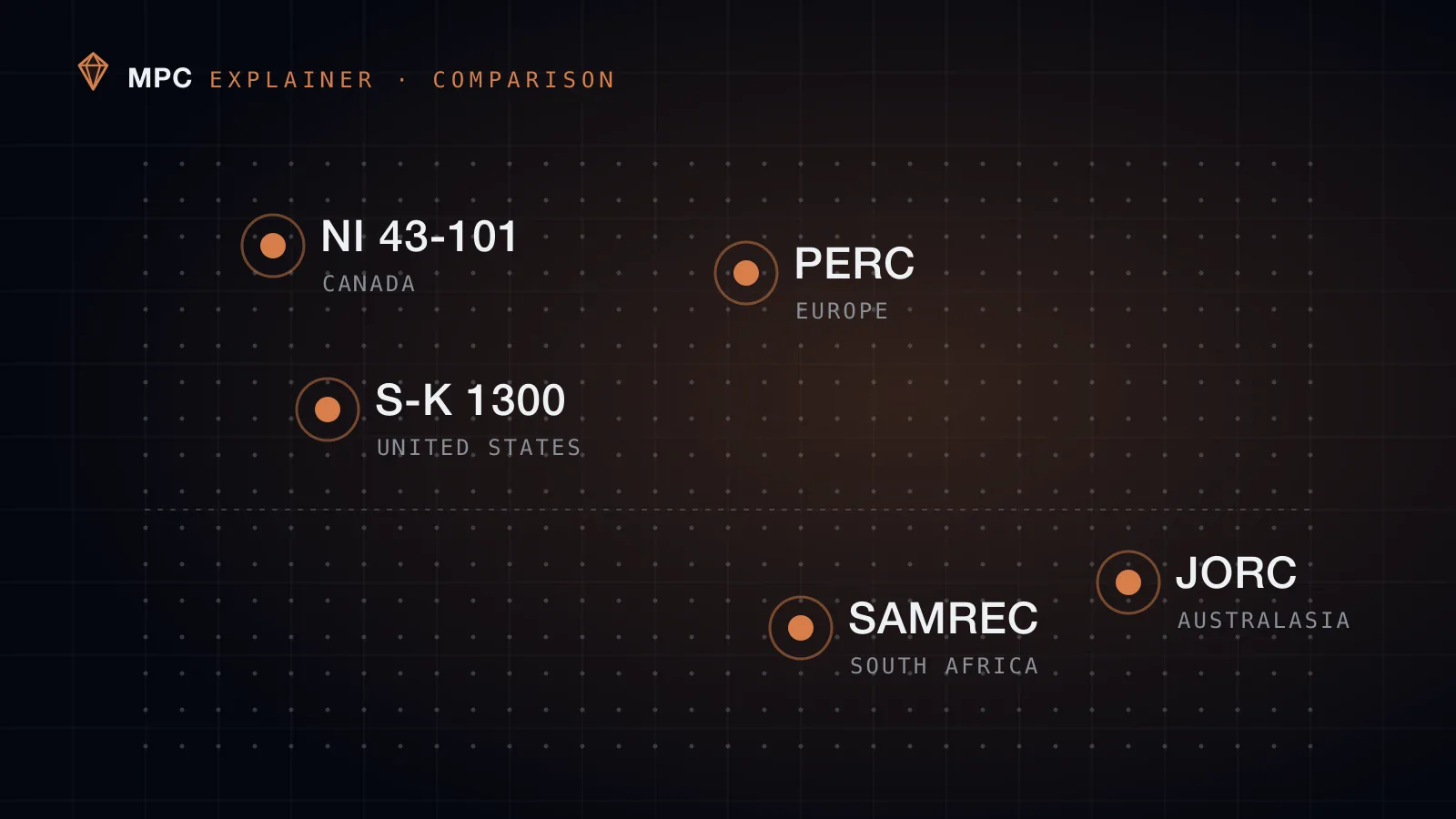
JORC, NI 43-101 and S-K 1300 set different requirements for public disclosure of mineral exploration results, resources and reserves. PERC and SAMREC provide regional reporting frameworks. Each identifies who takes professional responsibility, what information is disclosed and how mineral confidence is classified. The applicable regime depends on issuer, filing and market.
The five-code reporting matrix
Mining projects can operate across international markets, but technical reporting requirements differ depending on the issuer, listing venue, regulatory jurisdiction and purpose of disclosure.
Five important frameworks are the JORC Code, National Instrument 43-101, SEC Regulation S-K Subpart 1300, the PERC Reporting Standard and the SAMREC Code.
Although these frameworks share internationally recognised resource and reserve concepts, they are not interchangeable regulatory instruments. Each has its own reporting requirements, professional qualifications, documentation expectations and application.
The matrix below summarises their principal characteristics. Edition and effective dates were checked against the sources listed under it on 17 November 2026.
| Framework | Jurisdiction | Regulator or sponsor | Who signs off | Resource and reserve categories | Principal reporting document | Current edition and date |
|---|---|---|---|---|---|---|
| JORC | Australia and New Zealand | JORC Committee; ASX and NZX listing frameworks | Competent Person | Inferred, Indicated, Measured; Probable and Proved Ore Reserves | Public Report, supporting documentation and Table 1 disclosures | JORC Code 2012 Edition; released 20 December 2012, mandatory from 1 December 2013 |
| NI 43-101 | Canada | Canadian Securities Administrators and provincial or territorial securities regulators | Qualified Person | Inferred, Indicated, Measured Mineral Resources; Probable and Proven Mineral Reserves | Form 43-101F1 Technical Report | Current consolidated instrument effective 9 June 2023; Form 43-101F1 effective 30 June 2011 |
| S-K 1300 | United States | US Securities and Exchange Commission (SEC) | Qualified Person | Inferred, Indicated, Measured Mineral Resources; Probable and Proven Mineral Reserves | Technical Report Summary (TRS), where required | Regulation S-K Subpart 1300; compliance required for fiscal years beginning on or after 1 January 2021 |
| PERC | Europe | Pan-European Reserves and Resources Reporting Committee; relevant national regulators and professional organisations | Competent Person | Inferred, Indicated, Measured Mineral Resources; Probable and Proved Mineral Reserves | Public Report and supporting Competent Person documentation, including applicable Table 1 disclosures | PERC Reporting Standard 2021; issued 1 October 2021 |
| SAMREC | South Africa | SAMREC/SAMVAL Committee; JSE listing framework and professional organisations | Competent Person | Inferred, Indicated, Measured Mineral Resources; Probable and Proved Mineral Reserves | Public Report, Competent Person's Report and SAMREC Table 1 | SAMREC Code 2016 Edition; mandatory from 1 January 2017 |
The matrix is a comparative starting point. Actual reporting obligations depend on the applicable instrument, listing requirements, issuer circumstances and disclosure trigger. A reporting code should never be selected only because it appears familiar or internationally recognised.
Edition and update status as of 17 November 2026
JORC: The JORC Code 2012 Edition remains the current edition. A review of the Code is ongoing: JORC presented an update on the review at a webinar on 20 August 2026, and its March 2026 update described a provisional Code being finalised for review by CRIRSCO, ASX, ASIC and the parent bodies. A replacement will operate only after further approval and a transition period, so the 2012 Code should be distinguished from proposed revisions.
NI 43-101: The current consolidated instrument is effective from 9 June 2023. The Canadian Securities Administrators published a proposed repeal and replacement on 12 June 2025, followed by a proposed amendment on 14 May 2026. Neither proposal has an effective date, and neither is a rule in force.
The CIM Definition Standards 2014 are incorporated by reference into NI 43-101. On 30 October 2026, CIM opened a public comment period on proposed revisions, closing on 4 January 2027.
S-K 1300: The SEC adopted its modernised mining property disclosure rules on 31 October 2018. Registrants were required to comply for fiscal years beginning on or after 1 January 2021.
PERC: The 2021 edition superseded previous versions and has been mandatory for PERC member organisations since 1 January 2023.
SAMREC: The 2016 edition superseded earlier editions and became mandatory from 1 January 2017.
Primary references: JORC Code Updates, BC Securities Commission: NI 43-101, SEC Mining Disclosure Guide, PERC Standard, SAMCODES and CIM Definition Standards Update.
What is the JORC Code?
The JORC Code is the Australasian Code for Reporting of Exploration Results, Mineral Resources and Ore Reserves. It establishes minimum standards for public reporting and classifies mineral information according to geological confidence and technical and economic considerations. Public reporting requires supporting documentation prepared by an appropriately qualified Competent Person.
The JORC Code was first published in 1989, with subsequent revisions in 1992, 1996, 1999, 2004 and 2012. The current published edition is the JORC Code 2012 Edition.
Its principal application is public reporting by mining companies, particularly those subject to Australian and New Zealand exchange requirements.
The standard emphasises three principles:
- Transparency: Relevant information must be presented clearly and without misleading omissions.
- Materiality: Reporting must include information that investors and their advisers reasonably require.
- Competence: Technical information must be prepared or supervised by appropriately experienced professionals.
A JORC report must accurately reflect the underlying technical documentation. The Competent Person is responsible for the work within their scope and must provide the required consent for public reporting.
The JORC Code also uses Table 1, a systematic checklist covering exploration results, resources and reserves. The approach is commonly described as "if not, why not": relevant criteria must be addressed or the omission justified.
For the official edition and supporting materials, consult the JORC Library.
What is NI 43-101?
National Instrument 43-101 is the Canadian securities regulatory instrument governing public disclosure of scientific and technical information about mineral projects. It requires relevant disclosures to be based on qualified professional work and establishes when a prescribed technical report must be filed.
Unlike JORC, which is a professional reporting code incorporated into exchange requirements, NI 43-101 is a securities instrument administered through Canada's provincial and territorial regulatory framework.
The instrument works alongside the CIM Definition Standards, which establish the definitions and guidance for Mineral Resources, Mineral Reserves and mining studies used in Canada.
What is an NI 43-101 technical report?
An NI 43-101 technical report is the report prepared under Form 43-101F1. It summarises material scientific and technical information concerning mineral exploration, development and production activities on a property that is material to the issuer.
Its principal requirements include:
- Identification of the mineral property and issuer.
- Property location, ownership and relevant agreements.
- Geological setting and mineralisation.
- Exploration activities and drilling information.
- Sampling, analytical procedures and data verification.
- Mineral resource and reserve estimates where applicable.
- Mining methods and technical studies for advanced projects.
- Environmental, permitting and economic considerations where required.
The report must be prepared by or under the supervision of one or more Qualified Persons, dated and signed in accordance with the instrument.
For Canadian companies, the CIM Definition Standards remain an important reference because NI 43-101 incorporates their mineral resource and reserve definitions. The 2014 CIM definitions are under review as of November 2026, but proposed revisions should not be confused with the incorporated definitions currently in force.
Primary references: Current NI 43-101 and 2014 CIM Definition Standards.
What is S-K 1300?
S-K 1300 refers to Subpart 1300 of Regulation S-K, the US Securities and Exchange Commission's mining property disclosure framework. It sets requirements for SEC registrants whose mining operations are material to their business or financial condition, including qualified professional involvement and technical report summaries.
The framework modernised the United States' approach to mining property disclosures and replaced the previous Industry Guide 7 framework for applicable registrants.
Its main reporting requirements include:
- Disclosure of material mining properties.
- Exploration results and related activities where material.
- Classification of Mineral Resources into Inferred, Indicated and Measured.
- Disclosure of Mineral Reserves as Probable or Proven.
- Technical Report Summaries supporting resource and reserve disclosures when required.
A Qualified Person must prepare or supervise the relevant technical information.
A dated and signed Technical Report Summary must be filed when a registrant discloses mineral resources or reserves on a material property for the first time, or when there is a material change from the last summary filed. Filing one to support exploration results is optional.
The SEC framework also requires the initial assessment of mineral resources to consider whether there are reasonable prospects for economic extraction.
For Mineral Reserves, a Qualified Person must evaluate the relevant Modifying Factors and establish the economic viability of the mining property through the required technical and economic studies.
S-K 1300 applies to companies that file with the SEC, wherever their investors are located.
Official reference: SEC Modernization of Property Disclosures for Mining Registrants.
PERC and SAMREC in brief
Beyond Australia, Canada and the United States, other frameworks set regional approaches to public mineral reporting.
PERC: European reporting
The PERC Reporting Standard sets minimum standards and guidance for public reporting of Exploration Results, Mineral Resources and Mineral Reserves within Europe.
PERC is a member of the CRIRSCO family and serves as the National Reporting Organisation for the Europe region.
The PERC Reporting Standard 2021 applies to solid mineral raw materials where public reporting is required by the relevant regulatory authority.
A Competent Person must prepare or supervise the relevant documentation, meet professional membership requirements and have at least five years of relevant experience.
The standard also provides reporting guidance and Table 1 disclosures, which give companies evaluating European mining projects a regional framework aligned with internationally recognised reporting concepts.
SAMREC: South African reporting
The South African Code for the Reporting of Exploration Results, Mineral Resources and Mineral Reserves is commonly known as the SAMREC Code.
The SAMREC Code sets minimum requirements for public mineral reporting in South Africa and is incorporated into the relevant JSE listing framework.
The 2016 edition covers exploration results, mineral resources, mineral reserves, technical studies and supporting disclosure requirements.
A Competent Person must meet the applicable professional registration or membership requirements and have relevant experience in the mineralisation style and activity being reported.
SAMREC also includes Table 1 and a framework for documenting the qualifications and responsibilities of the professionals involved.
Official references: PERC Reporting Standard and SAMCODES Reporting Documents.
How the codes fit together: CRIRSCO
CRIRSCO stands for the Committee for Mineral Reserves International Reporting Standards.
It promotes internationally consistent definitions and reporting principles for mineral exploration results, resources and reserves. Its International Reporting Template is the basis for alignment between national and regional reporting frameworks.
These include:
- JORC in Australasia.
- SAMREC in South Africa.
- PERC in Europe.
- CIM definitions in Canada.
- SME guidance in the United States.
The relationship does not mean that every framework has identical legal requirements.
The CRIRSCO approach promotes consistency in core resource and reserve terminology, professional responsibility and reporting principles while allowing individual jurisdictions to keep their own regulatory requirements.
The June 2024 CRIRSCO International Reporting Template draws together the reporting concepts used across these frameworks.
So when JORC, NI 43-101 and S-K 1300 are compared, their mineral classification concepts are similar, but their disclosure instruments, filing obligations and professional requirements remain jurisdiction-specific.
Official reference: CRIRSCO International Reporting Template 2024.
Competent Person vs Qualified Person
The terms Competent Person and Qualified Person both refer to professionals responsible for mineral reporting and technical information. Their definitions, professional requirements and legal responsibilities depend on the applicable framework.
| Competent Person | Qualified Person |
|---|---|
| Used by JORC, PERC and SAMREC reporting frameworks. | Used under NI 43-101 and SEC S-K 1300. |
| Must have relevant experience in the mineralisation style, deposit type and activity being reported. | Must meet the applicable experience, professional qualification and recognised membership requirements. |
| Usually requires membership or registration with a recognised professional organisation. | Requires membership, registration or licensing under the relevant instrument. |
| Responsible for technical documentation and public reporting within the relevant code. | Responsible for technical information and reports required under the applicable regulatory instrument. |
| May be required to provide written consent and professional certification. | May be required to prepare, supervise, sign and certify technical reports or summaries. |
Competent Person requirements
Under the JORC Code, a Competent Person must be a member or fellow of AusIMM, the Australian Institute of Geoscientists or a recognised professional organisation.
The person must have at least five years of relevant experience in the style of mineralisation or deposit type and the specific activity being undertaken.
SAMREC similarly requires a recognised professional registration or membership and at least five years of relevant experience.
Qualified Person requirements
Under NI 43-101, a Qualified Person must have relevant engineering or geoscience qualifications, at least five years of relevant professional experience and good standing with a qualifying professional association.
Under S-K 1300, a Qualified Person must be a mineral industry professional with at least five years of relevant experience and membership or licensing with a recognised professional organisation.
The professional title alone does not establish that someone is qualified to assess every type of mineral project. A professional experienced in gold exploration may not have the relevant expertise to estimate resources for a different geological deposit type.
What is a competent person report?
A competent person report is technical documentation prepared by a Competent Person describing the scope of work, supporting information, technical conclusions and limitations relevant to a mining project.
Its content depends on the project stage and reporting requirements. It may cover exploration activities, mineral resource estimates, reserve evaluations and other technical studies.
A Competent Person's report should identify the professional responsible and provide the appropriate supporting documentation. It should not be confused with a generic geological report prepared without reference to a recognised reporting framework.
Resource and reserve categories across the codes
Although the five frameworks have different regulatory structures, their resource and reserve classification systems share broadly aligned concepts.
Exploration Results
Exploration Results describe information obtained through geological investigation, drilling, sampling, geophysical surveys and other exploration activities.
They may indicate mineralisation or geological potential, but they do not establish a Mineral Resource.
Mineral Resources
The main categories are:
Inferred Mineral Resource: The lowest confidence category. Geological evidence and sampling are limited, and continuity is implied rather than verified.
Indicated Mineral Resource: A higher confidence category supported by more reliable geological information, allowing the application of Modifying Factors for mine planning and evaluation.
Measured Mineral Resource: The highest confidence category, supported by detailed and reliable exploration, sampling and testing.
These categories reflect increasing confidence in geological information and the quantity and quality of available data.
Mineral Reserves
Mineral Reserves are the economically mineable parts of Measured or Indicated Mineral Resources after applicable Modifying Factors are considered.
Probable Mineral Reserve: An economically mineable part of an Indicated Mineral Resource and, in certain circumstances, a Measured Mineral Resource.
Proved Mineral Reserve: An economically mineable part of a Measured Mineral Resource with a high degree of confidence in the relevant Modifying Factors.
NI 43-101 and S-K 1300 use the term Proven rather than Proved.
A Mineral Resource reported under JORC does not become a Mineral Reserve without further technical and economic assessment. Proof of Reserves vs Ore Reserves explains how these reserve categories differ from custody-based reserve claims.
Which code applies to my project?
The relevant reporting framework depends mainly on the issuer, listing venue, jurisdiction and intended disclosure. The table below is a starting point.
| Project or issuer situation | Framework to examine | Important consideration |
|---|---|---|
| Australian listed mining company | JORC | ASX Listing Rules and applicable JORC requirements. |
| New Zealand listed mining company | JORC | Relevant NZX listing and disclosure obligations. |
| Canadian reporting issuer | NI 43-101 | Canadian securities requirements and CIM definitions. |
| US SEC registrant with material mining operations | S-K 1300 | SEC disclosure requirements and Qualified Person obligations. |
| European public mining disclosure | PERC | Relevant national regulatory and listing requirements. |
| South African listed mining company | SAMREC | JSE Listing Requirements and SAMREC reporting requirements. |
| Company listed in multiple jurisdictions | Multiple applicable frameworks | Cross-listing and disclosure obligations may require more than one reporting regime. |
Questions to start with
- Where is the issuing company incorporated and regulated?
- Where are its securities listed or offered?
- Which securities regulators receive its public disclosures?
- Where are its intended investors located?
- What type of technical information is being disclosed?
- Does the filing trigger a prescribed technical report or professional certification?
Investor location is relevant, but it does not by itself determine the applicable reporting code.
For example, a Canadian issuer may have investors in Australia and Singapore while remaining subject to Canadian securities disclosure requirements. A company listed in multiple markets may have to meet more than one regime.
Is a JORC report accepted by Canadian or US regulators?
There is no universal acceptance rule.
In Canada, disclosure must comply with NI 43-101 where it applies. Part 7 of the instrument lets certain issuers use an acceptable foreign code, a category that includes JORC, under conditions the instrument sets. Where a technical report is required, it follows Form 43-101F1 and is prepared by or under the supervision of a Qualified Person meeting the instrument's requirements.
In the United States, a JORC report does not automatically satisfy S-K 1300. An SEC registrant must meet the applicable Subpart 1300 disclosure requirements, including Qualified Person and Technical Report Summary requirements where triggered.
International reporting alignment can make technical information easier to compare across markets, but it does not replace the applicable regulator's filing rules.
Companies preparing cross-border disclosures should obtain advice from the relevant exchange, securities counsel and qualified mining professionals.
What a reporting code does not tell you
A compliant technical report is an important source of information for investors and project stakeholders. It has a defined purpose and scope.
A reporting code does not guarantee:
- The economic value of a mineral deposit.
- Future commodity prices or market demand.
- The ability to obtain permits or regulatory approvals.
- The financial viability of a mining operation.
- The successful development or production of a mine.
- The accuracy of future forecasts or assumptions.
- The legal eligibility of a digital asset offering.
A report describes what is known, how it was assessed and the level of confidence attached to the information at its effective date.
JORC-compliant documentation is evidence of compliance with the reporting framework, not a guarantee of investment performance.
Mineral resource and reserve estimates involve uncertainty. New drilling, laboratory results, geological interpretations and economic assumptions may change the reported classification.
The same distinction applies to digital asset infrastructure. A blockchain can preserve a reference to a technical report and help establish the integrity of a recorded document. It cannot establish that the underlying mineral deposit exists in the quantity or quality described.
The Verification ≠ Guarantee chapter of the MPC dApp guide sets out these limits in more detail.
Why this matters for tokenized mining assets
Before any physical mining project can be represented through an eligible digital asset structure, its underlying information must be organised and assessed. Reporting codes are one of the main sources of that assessment.
Global MPC is building a verification layer designed to connect physical project information with professional review and structured digital records. The design separates three judgements:
- Data readiness: whether the required project material and professional reviews are in place.
- Protocol onboarding: whether MPC will support the project technically, decided by MPC Protocol Governance.
- Legal issuance: whether the project-specific issuer, asset rights and regulatory arrangements allow potential token issuance.
Technical verification, platform support and legal issuance establish different things, so these decisions stay separate. The Three Judgments chapter of the dApp guide explains the separation, and the whitepaper chapter Trust & Compliance covers the compliance side.
MPC has not published a list of reporting codes its verification process requires. Where a report prepared under a recognised code exists, it should be included, and a project without one should not be described as having a resource or reserve. What a Mining Project Needs Before Tokenization lists the records to prepare, and mine operators can check their readiness in Mine Financing Options and Tokenization.
The Tsagaan Tolgoi reference case and its documentation log show how exploration-stage project documentation is organised within the MPC framework. Its published materials should be read within their stated technical limits: no JORC- or other CRIRSCO-compliant mineral resource or reserve report has been issued for the project. The field and laboratory records are on Technical Reports.
FAQs
What is the difference between JORC and NI 43-101?
Both set rules for publicly reporting exploration results, mineral resources and reserves. The JORC Code is the Australasian code and relies on a Competent Person. NI 43-101 is a Canadian securities rule and relies on a Qualified Person and a prescribed technical report under Form 43-101F1.
What is S-K 1300 and who must follow it?
S-K 1300 is Subpart 1300 of Regulation S-K, the US Securities and Exchange Commission's mining property disclosure rules for companies that file with the SEC. A registrant must comply when its mining operations are material to its business or financial condition. Required disclosures must be supported by a Qualified Person.
What is CRIRSCO?
CRIRSCO is the Committee for Mineral Reserves International Reporting Standards. It maintains an international template that promotes consistent definitions and reporting principles. National and regional frameworks such as JORC, SAMREC and PERC are aligned with the CRIRSCO reporting approach.
Is a JORC report accepted in Canada or the United States?
It depends on the regulator and filing. Codes in the CRIRSCO family share definitions, but each regulator sets its own requirements. A JORC report does not automatically replace NI 43-101 or S-K 1300 obligations. Confirm the applicable requirements with the relevant exchange or legal counsel.
Which reporting code does Global MPC require for verification?
MPC has not published a list of required reporting codes. A JORC or NI 43-101 report is not required for every exploration-stage project; where one exists it should be included. MPC has not published a mineral resource estimate for Tsagaan Tolgoi.
Does a compliant report guarantee a project's value?
No. A compliant report describes the available evidence, technical conclusions and level of confidence as of its effective date. It does not guarantee economic viability, permitting, future production, commodity prices or investment returns.
MPC Team, globalMPC
November 18, 2026